AI
September 30, 2026

What We Heard and Showed at Informa Connect East: Hands-On AI for Clinical Finance


Key takeaways

We had a great time at Informa Connect's Finance for Bioscience East in Boston last week. Thanks to everyone who stopped by the booth to see our new Clinical Finance AI Agent in action, joined us at the Red Sox game, and packed the room for our panel. We came home with a full notebook and a lot of energy.

What we heard at the show

Everyone knows they need AI. What's less clear is where to start and how to scale.

That came through in the room. When I polled the over 100 people who joined our panel session, roughly half said they're still figuring out where to start or how to scale. That matches what we saw in a recent Condor webinar, where 60% of attendees said they don't know where to begin.

We also noticed something else: there was noticeably less AI hype at the show this year, and attendees appreciated it. What people wanted instead were practical, hands-on examples of how AI can actually help clinical finance teams do their jobs.
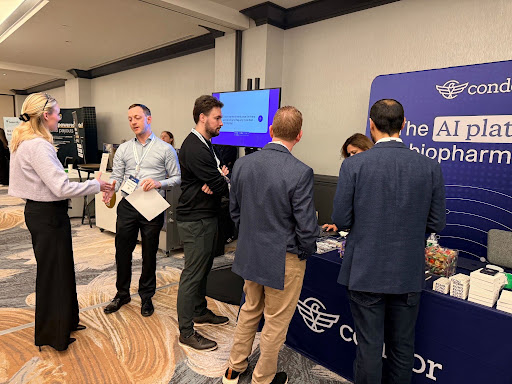
Condor Team at Informa Connect East 2026

Practical AI, live on stage

That's exactly what David Towslee at Intellia Therapeutics and I set out to deliver in our session, Navigating Clinical Trials Finance: Accruals, Automation and AI Integration. Instead of slides full of promises, we ran live demos using a tool nearly everyone in the room already had on their laptops: Microsoft Copilot.

Here's what we covered.

The bottleneck is moving from the lab to the ledger

We opened by setting the table. AI is evolving faster than enterprises can adopt it. Cloud software took 12 to 14 years to become embedded in everyday work; AI is moving in roughly 90-day cycles. Waiting for a steady state before you adopt isn't a strategy at all.

That pace matters for clinical finance in a specific way. AI has already accelerated drug discovery, which means more candidates are making it into the clinic. Each of those candidates becomes a clinical trial, and each trial becomes a stack of CRO contracts, vendor agreements, and site CTAs that land on the finance team. Many teams are still running on PDFs and spreadsheets built for a lower-volume world. If those processes don't evolve, clinical finance risks becoming the constraint instead of the accelerant.

David added that the demand he sees is for speed: faster scenario planning, faster answers for strategic decisions. "You don't have a month to run back and redo your whole model," he said. "You're going to need to turn this over in a day or two in some cases."

Use case #1: CRO change order analysis

Change orders are one of the most persistent pain points in clinical finance, and the numbers explain why. Protocols with at least one substantial amendment are up 19 points over the last decade, four out of five Phase 3 protocols are now amended, and the average trial sees 3.3 major amendments. Every amendment drives downstream vendor change orders, and the average Phase 3 vendor change order runs about $535,000. For a company with eight trials in the pipeline, that can mean 40 to 50 change orders and roughly $10 million in unplanned spend.

Meanwhile, change order volume has roughly doubled while finance team headcount has stayed flat. I built change order budgets earlier in my career at a CRO, and pointed to the negotiation asymmetry: vendors can spend months building a change order, then ask the sponsor to review it in a week.

David described how his team uses AI to push back on that asymmetry. They feed multiple contract versions into an LLM and ask for a concise summary of unit changes, price changes, adds, and deletes. "AI is not giving you the answer per se," he said. "But it points you right to where you need to look. There's the data. You just need to go tell the story now."

Then I ran a live demo, loading a sample Phase 3 change order into Copilot with this prompt:

I'm a finance director at a biotech company. I've received the attached change order budget from the CRO for a Phase 3 study. Please analyze it and give me: a summary of the total cost change and the top five largest cost increases; a breakdown of direct fees vs. pass-throughs vs. investigator costs; any line items that appear to be retrospective or cover work already performed; and a list of five questions I should ask the CRO before approving this. Format the output as a brief memo I can share with my CFO.

Within seconds, Copilot summarized the total cost change, identified the largest increases, flagged potentially retrospective work, and surfaced a telling commercial observation: site count was up 54% while patient count was unchanged. It also generated sharp questions for the CRO, including why monitoring costs were rising with no increase in patients.

Use case #2: Investigator grant review

Investigator grants are nearly half of per-trial costs (48%), averaging about $6,900 per patient, and on a large Phase 3 study they can generate tens or hundreds of thousands of line items. The stakes extend to sites, too: 43% of sites report having three months or less of cash on hand, and among sites that drop out of trials, 40% cite payment delays as the primary reason.

Part of the difficulty is structural. Activity data lives in EDC, IRT, and CTMS systems, while finance sees only CRO invoices. Every site contract is formatted differently. Protocol amendments reprice studies midstream. And invoiceables often accrue in the dark until they show up on a bill. I shared the story of a mid-cap oncology sponsor that received a $5 million bill for previously unreported invoiceables at trial closeout. Automation without reconciliation just makes the wrong payment happen faster.

David's team uses AI to sift through CRO payment reports: pulling out invoiceables, comparing month-over-month balances, summarizing by site and country, and checking billed amounts against contracted rates. "It's not necessarily a capability issue, it's just time," he said.

The second demo used a similar prompt on a sample investigator grant payment report, asking for total payments by site and month, a breakdown of visit payments vs. procedures vs. invoiceable pass-throughs, any payments inconsistent with site budgets or completed visits, an estimate of what to accrue for work performed but not yet paid, and five questions for the CRO. The output caught real exceptions, including a visit performed in December but not paid until May, and standalone ECG payments without an associated visit.

Where generic AI stops

David and I were candid about the limits. A generic LLM only knows what's in the document you give it. It isn't connected to your operational systems, so it doesn't know how many patients have enrolled or how many sites are active. It can't reliably spot unlabeled retroactive work without additional context. It caps how many documents you can upload at once, which rules out analyzing hundreds of site contracts. And it's non-deterministic: I ran the same prompt the day before and got a response that was similar, but not identical.

In finance and accounting, the numbers are the numbers. That 5% difference is where teams can get into trouble. Generic AI does a great job of getting you from zero to informed, but not to defensible.

David was equally direct. Don't let AI calculate numbers you'll report without validating them. Ask for check calculations, understand how it got there, and use it for directionality and noise reduction rather than final answers.

Key takeaways

  • Start with work you've already done. David's advice for building confidence: pick a month you've already closed, build a prompt that recreates your manual analysis, and confirm it matches. Then run it on the next month.
  • Use reverse prompting. Iterate with the LLM until the output is exactly what you want, then ask it to write the prompt that would get you there next time. Save it and reuse it.
  • Build a shared prompt library. David's team spends about 10 minutes of every team meeting discussing how they're using AI, and maintains a library of common prompts, such as variance analyses, that anyone on the team can adapt.
  • Make time to experiment. Our team runs quarterly hackathons: a few hours on a Friday afternoon to identify a problem, build an AI solution, and test it together.
  • Try the in-app plugins. David's single recommendation for Monday: experiment with AI plugins in Word, Excel, and PowerPoint. Seeing changes happen live, and iterating in real time, is far faster than the old prompt-wait-revise loop.
  • Check your AI policy first. Before putting confidential data into any tool, confirm it's licensed and approved by your IT team. Enterprise plans from the major providers generally don't train on your data; free tools may not offer the same protections.
  • Weigh build vs. buy honestly. Homegrown tools can be tailored to your workflows but depend on IT bandwidth. Purpose-built platforms bring connected data, auditability, and rigorous security. The right answer depends on your resources and how far you want to go.

Helping the industry get started, and scale

The questions we heard in Boston are the ones we hear from R&D teams every week: Where do I start? How do I trust the output? How do I go from one-off prompts to something repeatable? Our goal is to keep answering them with practical, hands-on guidance that clinical finance teams can put to work right away, whether or not they're Condor customers.

A big thank you to David for joining Jeff on stage and sharing so openly, and to everyone who attended and asked great questions.

Go deeper

Here are the slides from our presentation. Once we get the recording from Informa, we’ll add that here too.

If you want to keep exploring practical applications of AI in clinical finance, start here:

Read more

Life Sciences
October 6, 2026

How to Manage CRO Change Orders and Control CRO Costs in Clinical Trials

For most biopharma sponsors, the CRO contract is the single largest commitment in a trial budget. But the number you sign is rarely the number you pay. Between the initial work order and study closeout, a steady stream of change orders reshapes the budget, and each one lands on the desks of clinical operations and finance teams who are already stretched thin.

Managing CRO costs well comes down to one question: when a change order arrives, can you tell what's legitimate and what isn't, fast enough to matter? This post walks through why that's so difficult, how teams have tried to solve it, and how Condor changes the equation with AI. 

How to manage CRO costs in clinical trials

Controlling CRO spend isn't about a single negotiation at contract signing. It's a discipline that runs the full life of the study, and it rests on four habits:

  1. Anchor every cost to its driver. Every line in a CRO budget is ultimately a function of something operational: patients enrolled, sites activated, visits completed, months of study duration. When you know which driver moves which line item, you can tell whether a proposed increase actually follows from a scope change.
  2. Keep the original contract close. Unit prices, assumptions, and fee schedules in the original work order are your baseline. A change order should adjust scope, not quietly reprice work you've already agreed on.
  3. Track what's already been done. Work that has already been performed but not yet recognized is one of the most common sources of surprise costs. If you don't know where the study actually stands, you can't tell whether a change order is billing retroactively.
  4. Know what the change should cost before the CRO tells you. The strongest negotiating position is having your own independent number in hand. Without it, you're reacting to the CRO's figure instead of evaluating it.

These four habits are simple in principle, but hard in practice.

Why CRO change orders are so hard to manage

Change orders have gone from occasional to nearly universal. Protocol amendments - the main trigger for change orders - now affect about 76% of clinical trials, up from 57% a decade ago. In Phase 3, it's 82%, with an average of 3.3 substantial amendments per trial. The later the phase, the bigger the bill: a Phase 3 change order averages roughly $535,000, which is close to four times the Phase 2 average, and takes about three months to negotiate.

Scale that across a portfolio and the numbers get serious. A biotech running eight active studies can expect 40 to 50 change orders across its CROs and ancillary vendors, representing $10 million or more in unplanned, unbudgeted cost. Meanwhile, change order volume has roughly doubled over the past decade while finance headcount has stayed flat. That gap gets absorbed with overtime, missed forecasts, and long weekends.

Volume is only part of it. The documents themselves are built to be hard to review:

The incentives are misaligned. CROs sometimes lowball initial bids, counting on the change order process to recover margin. Once a trial is underway, switching CROs midstream is so costly that sponsors have little leverage.

The information is asymmetric. A change order can be in development at the CRO for months, then arrive with a request to approve it in a week or two. Line-item explanations are often a sentence or two, and unit price increases can be tangled up with legitimate scope changes.

Retroactive work is buried. It's not always clear which scoped work has already occurred. Even well-run CROs struggle to recognize out-of-scope work consistently, and on milestone contracts you may have no visibility into what's been performed. The result is often a large true-up bill at the end.

There's no system of record. Out-of-scope reporting is inconsistent, unit pricing varies across and within trials, and version control can be chaotic. It's not unusual for a CRO to accept a sponsor's pushback in one version, then revert the change in a later one without anyone catching it.

The internal mechanism of a CRO is highly manual and disaggregated. One group manages unit recognition, another builds change order budgets, and a third handles invoicing, often in systems that don't talk to each other. That's how a sponsor ends up billed for 300 remote monitoring visits when only 150 were budgeted.

How sponsors manage CRO change orders compounds the problem further. 

How teams have managed CRO change orders to date

Most sponsors handle change orders with some combination of spreadsheets, trackers, and sheer effort. A finance or clinical ops lead exports the CRO budget grid, which can run to hundreds of line items, and works through it line by line, sometimes literally with a ruler, comparing it against the original contract and whatever out-of-scope tracker exists. Questions go back to the CRO by email, a revised version comes back, and the cycle repeats four or five times.

When sponsors want to know what a scope change might cost in advance, they typically ask the CRO. The process on the CRO side is often less rigorous than it looks. When Jeff was at a CRO, a sponsor asking what it would cost to add 15 patients or expand into new regions would get a modeled estimate with a 20% buffer on top, delivered as a single ballpark number a week or two later. The sponsor gets an answer, but it's the CRO's answer, on the CRO's timeline.

More recently, teams have started using generic AI tools like Microsoft Copilot or ChatGPT for a first pass. That's a genuine improvement. With a well-structured prompt, a generic model can summarize what changed in a change order, identify the largest cost increases, and draft a CFO-ready memo in under a minute, with no procurement required. (We shared the exact prompt in our webinar recap).

But generic AI hits a ceiling quickly. It can tell you what a document says, not whether it's right. It has no knowledge of your original contract, your protocol history, or what "normal" looks like for a study like yours. It won't reliably catch unlabeled retroactive work, and it can return a different answer every time you run the same prompt. It gets you from zero to informed. But it doesn't get you to defensible.

How to manage CRO change orders with Condor’s AI platform

Condor is the AI platform for biopharma R&D. It's built on a proprietary clinical and financial ontology and knowledge graph, co-developed with Big 4 accounting firms, that maps how budgets, vendor contracts, sites, and clinical activity actually connect. That foundation is what lets Condor's AI reason about a change order the way an experienced clinical finance team would.

Condor supports change order management two ways: reviewing change orders once they arrive, and getting ahead of them before they do.

Reviewing a change order: from "what changed" to "what's wrong"

When a change order comes in, Talon, Condor's purpose-built AI analysis service, evaluates every line item against the original contract and the study's cost drivers. Instead of just summarizing changes, it makes judgment calls. Each line is sorted into a clear disposition: hard no, push back, needs clarification, or accept.

In a live demo, we ran a $2.25 million Phase 3 change order through Talon, an internally built AI analysis platform used by our customer success team. It found that roughly 94% of the dollar delta was unjustified, inadequately supported, or needed clarification. It identified $1.4 to $1.7 million in recoverable savings, along with a realistic settlement range of $556,000 to $856,000, since no CRO concedes everything.

The reasoning is what makes it useful. The largest increase in that change order was clinical monitoring, which the CRO had scaled with the number of added sites. Talon flagged that monitoring cost is driven primarily by patient volume and source data verification, not site count. Since patient enrollment wasn't changing, most of that increase didn't hold up. Talon reverse-engineered the expected cost from the original contract's drivers, showed the gap, and linked every finding back to the source cell in the budget grid. It then produced a negotiation brief with talking points the team could send straight back to the CRO.

Getting ahead of the change order: scenario planning

The bigger shift is flipping the sequence entirely. With Condor's clinical finance agent, you can model a scope change yourself, in plain language, before the CRO sends anything.

In the same demo, we asked the agent to forecast a scenario that mirrored the CRO's proposed change: add sites, keep the 48-month duration, and hold patient counts flat. In seconds, the agent loaded the study's forecast, recalculated it against the actual contract structure and cost drivers, and saved it as a new scenario. The result was a $629,000 incremental increase across the full trial, compared to more than $2 million in the CRO's change order for the same scope.

That's the difference between reacting and negotiating. When you know what a reasonable change order looks like before it arrives, the conversation starts from your number, not the CRO's.

Scenario planning works for any what-if your team is weighing. Behind on enrollment? You can compare the cost of adding countries versus adding sites. Unsure what a realistic enrollment rate looks like? Condor can reference comparable trials on ClinicalTrials.gov with similar indications, size, and site mix to back into a reasonable assumption.

The benefits of managing CRO change orders with Condor

You recover real money. One commercial-stage pharma sponsor running 20 studies has saved more than $21 million in unjustified CRO billings in under two years with Condor. Across our customers, teams see up to 30% budget savings, alongside 90%+ forecast accuracy and 70% faster month-end close.

You negotiate from a position of strength. Scenario planning gives you an independent, defensible estimate before the CRO's number arrives. That reverses the information asymmetry that CROs have historically relied on.

Your findings are defensible. Condor's deterministic math layer produces consistent answers every time, with AI reasoning layered on top. Every finding traces back to its source. The platform includes a full audit trail of every change, whether made by a user or an agent, with SOX controls, sign-offs, and user permissions built in. Condor is SOC 1 Type 2 and SOC 2 Type 2 compliant.

You catch what's hidden. Line-item comparisons to the original contract, driver-level analysis, and retrospective flags surface the costs that generic tools miss, including unit price creep, retroactive billing, and increases that don't follow from the actual scope change.

You close the capacity gap. Change order volume has doubled while team sizes haven't. Condor absorbs the line-by-line review work so your team can spend its time on judgment and negotiation rather than untangling budget grids.

It extends beyond CROs. The same approach applies across your vendor portfolio, including labs, patient recruitment vendors, and site CTAs. Condor integrates directly with your ERP, EDC, contract, and procurement systems, so there's no need for special templates or manual data transformation.

Stop reacting to change orders

Protocol amendments aren't going away, and neither are change orders. What can change is how prepared your team is when one arrives. Generic AI can tell you what a change order says. Condor tells you what it's hiding, and helps you know what it should cost before it ever reaches your desk.

Want to see what this looks like with your own studies? Book a demo with our team.

Read the article

AI
September 30, 2026

What We Heard and Showed at Informa Connect East: Hands-On AI for Clinical Finance

We had a great time at Informa Connect's Finance for Bioscience East in Boston last week. Thanks to everyone who stopped by the booth to see our new Clinical Finance AI Agent in action, joined us at the Red Sox game, and packed the room for our panel. We came home with a full notebook and a lot of energy.

What we heard at the show

Everyone knows they need AI. What's less clear is where to start and how to scale.

That came through in the room. When I polled the over 100 people who joined our panel session, roughly half said they're still figuring out where to start or how to scale. That matches what we saw in a recent Condor webinar, where 60% of attendees said they don't know where to begin.

We also noticed something else: there was noticeably less AI hype at the show this year, and attendees appreciated it. What people wanted instead were practical, hands-on examples of how AI can actually help clinical finance teams do their jobs.

Condor Team at Informa Connect East 2026

Practical AI, live on stage

That's exactly what David Towslee at Intellia Therapeutics and I set out to deliver in our session, Navigating Clinical Trials Finance: Accruals, Automation and AI Integration. Instead of slides full of promises, we ran live demos using a tool nearly everyone in the room already had on their laptops: Microsoft Copilot.

Here's what we covered.

The bottleneck is moving from the lab to the ledger

We opened by setting the table. AI is evolving faster than enterprises can adopt it. Cloud software took 12 to 14 years to become embedded in everyday work; AI is moving in roughly 90-day cycles. Waiting for a steady state before you adopt isn't a strategy at all.

That pace matters for clinical finance in a specific way. AI has already accelerated drug discovery, which means more candidates are making it into the clinic. Each of those candidates becomes a clinical trial, and each trial becomes a stack of CRO contracts, vendor agreements, and site CTAs that land on the finance team. Many teams are still running on PDFs and spreadsheets built for a lower-volume world. If those processes don't evolve, clinical finance risks becoming the constraint instead of the accelerant.

David added that the demand he sees is for speed: faster scenario planning, faster answers for strategic decisions. "You don't have a month to run back and redo your whole model," he said. "You're going to need to turn this over in a day or two in some cases."

Use case #1: CRO change order analysis

Change orders are one of the most persistent pain points in clinical finance, and the numbers explain why. Protocols with at least one substantial amendment are up 19 points over the last decade, four out of five Phase 3 protocols are now amended, and the average trial sees 3.3 major amendments. Every amendment drives downstream vendor change orders, and the average Phase 3 vendor change order runs about $535,000. For a company with eight trials in the pipeline, that can mean 40 to 50 change orders and roughly $10 million in unplanned spend.

Meanwhile, change order volume has roughly doubled while finance team headcount has stayed flat. I built change order budgets earlier in my career at a CRO, and pointed to the negotiation asymmetry: vendors can spend months building a change order, then ask the sponsor to review it in a week.

David described how his team uses AI to push back on that asymmetry. They feed multiple contract versions into an LLM and ask for a concise summary of unit changes, price changes, adds, and deletes. "AI is not giving you the answer per se," he said. "But it points you right to where you need to look. There's the data. You just need to go tell the story now."

Then I ran a live demo, loading a sample Phase 3 change order into Copilot with this prompt:

I'm a finance director at a biotech company. I've received the attached change order budget from the CRO for a Phase 3 study. Please analyze it and give me: a summary of the total cost change and the top five largest cost increases; a breakdown of direct fees vs. pass-throughs vs. investigator costs; any line items that appear to be retrospective or cover work already performed; and a list of five questions I should ask the CRO before approving this. Format the output as a brief memo I can share with my CFO.

Within seconds, Copilot summarized the total cost change, identified the largest increases, flagged potentially retrospective work, and surfaced a telling commercial observation: site count was up 54% while patient count was unchanged. It also generated sharp questions for the CRO, including why monitoring costs were rising with no increase in patients.

Use case #2: Investigator grant review

Investigator grants are nearly half of per-trial costs (48%), averaging about $6,900 per patient, and on a large Phase 3 study they can generate tens or hundreds of thousands of line items. The stakes extend to sites, too: 43% of sites report having three months or less of cash on hand, and among sites that drop out of trials, 40% cite payment delays as the primary reason.

Part of the difficulty is structural. Activity data lives in EDC, IRT, and CTMS systems, while finance sees only CRO invoices. Every site contract is formatted differently. Protocol amendments reprice studies midstream. And invoiceables often accrue in the dark until they show up on a bill. I shared the story of a mid-cap oncology sponsor that received a $5 million bill for previously unreported invoiceables at trial closeout. Automation without reconciliation just makes the wrong payment happen faster.

David's team uses AI to sift through CRO payment reports: pulling out invoiceables, comparing month-over-month balances, summarizing by site and country, and checking billed amounts against contracted rates. "It's not necessarily a capability issue, it's just time," he said.

The second demo used a similar prompt on a sample investigator grant payment report, asking for total payments by site and month, a breakdown of visit payments vs. procedures vs. invoiceable pass-throughs, any payments inconsistent with site budgets or completed visits, an estimate of what to accrue for work performed but not yet paid, and five questions for the CRO. The output caught real exceptions, including a visit performed in December but not paid until May, and standalone ECG payments without an associated visit.

Where generic AI stops

David and I were candid about the limits. A generic LLM only knows what's in the document you give it. It isn't connected to your operational systems, so it doesn't know how many patients have enrolled or how many sites are active. It can't reliably spot unlabeled retroactive work without additional context. It caps how many documents you can upload at once, which rules out analyzing hundreds of site contracts. And it's non-deterministic: I ran the same prompt the day before and got a response that was similar, but not identical.

In finance and accounting, the numbers are the numbers. That 5% difference is where teams can get into trouble. Generic AI does a great job of getting you from zero to informed, but not to defensible.

David was equally direct. Don't let AI calculate numbers you'll report without validating them. Ask for check calculations, understand how it got there, and use it for directionality and noise reduction rather than final answers.

Key takeaways

  • Start with work you've already done. David's advice for building confidence: pick a month you've already closed, build a prompt that recreates your manual analysis, and confirm it matches. Then run it on the next month.
  • Use reverse prompting. Iterate with the LLM until the output is exactly what you want, then ask it to write the prompt that would get you there next time. Save it and reuse it.
  • Build a shared prompt library. David's team spends about 10 minutes of every team meeting discussing how they're using AI, and maintains a library of common prompts, such as variance analyses, that anyone on the team can adapt.
  • Make time to experiment. Our team runs quarterly hackathons: a few hours on a Friday afternoon to identify a problem, build an AI solution, and test it together.
  • Try the in-app plugins. David's single recommendation for Monday: experiment with AI plugins in Word, Excel, and PowerPoint. Seeing changes happen live, and iterating in real time, is far faster than the old prompt-wait-revise loop.
  • Check your AI policy first. Before putting confidential data into any tool, confirm it's licensed and approved by your IT team. Enterprise plans from the major providers generally don't train on your data; free tools may not offer the same protections.
  • Weigh build vs. buy honestly. Homegrown tools can be tailored to your workflows but depend on IT bandwidth. Purpose-built platforms bring connected data, auditability, and rigorous security. The right answer depends on your resources and how far you want to go.

Helping the industry get started, and scale

The questions we heard in Boston are the ones we hear from R&D teams every week: Where do I start? How do I trust the output? How do I go from one-off prompts to something repeatable? Our goal is to keep answering them with practical, hands-on guidance that clinical finance teams can put to work right away, whether or not they're Condor customers.

A big thank you to David for joining Jeff on stage and sharing so openly, and to everyone who attended and asked great questions.

Go deeper

Here are the slides from our presentation. Once we get the recording from Informa, we’ll add that here too.

If you want to keep exploring practical applications of AI in clinical finance, start here:

Read the article

AI
September 13, 2026

Introducing the World’s First Clinical Finance AI Agent Purpose-Built for Biopharma

Today we unveiled Condor's Clinical Finance AI Agent — the world's first AI agent purpose-built for biopharma R&D finance.

Ask it why a trial's actuals and forecast diverged, and it reasons across your full budget and forecast history to give you the answer in seconds, not the days it takes to reconcile across your ERP, CTMS, EDC, and a dozen spreadsheets. Ask it what a change in site mix or enrollment timing will cost you, and it runs the scenario and builds the resulting model directly in Condor. It doesn't just surface a number. It gives you the "why," and then it does the work.

This is a big milestone for our company and industry. It's also the moment I've been building toward since the day I started Condor.

The vision I had five years ago

When I founded Condor, I believed the financial machinery underneath every clinical trial could be fully automated, end-to-end, with AI reasoning on top of it. 

No more manually managing or outsourcing your finances. The numbers, built by an engine you can trust. Workflows run by AI. The why behind the numbers, uncovered in seconds instead of weeks, while there’s still time to act. 

Our new agent is the realization of that vision.

Why it took five years

Building AI that produces numbers you can actually trust is unbelievably hard. 

It took building Condor's financial engine first — a deterministic layer that follows defined rules, produces consistent output every time, and is fully auditable. No guessing, no black box, no "the model thinks it's probably right." Every number has to tie back to the clinical activity that actually drove it, because in this industry, a number nobody can defend is a number nobody will use.

It took building a knowledge graph grounded in a clinical and financial ontology we developed over years of work with Big 4 accounting firms — mapping how budgets, vendor contracts, clinical sites, and clinical activity actually connect to each other, across hundreds of studies and therapeutic areas. That ontology is what lets our agents understand a change order or a forecast variance the way a clinical finance team does, instead of the way a generic model guesses.

We built all of that first, five years ago, before there was a market pulling us to do it, because we knew it was the only foundation AI could stand on and still be trusted with a number that ends up in a board deck.

Recently, competitors that built their entire business model around outsourcing clinical finance — putting bodies behind the work instead of automating it — have realized AI is where our industry is headed. They're years behind, so the best they can offer is AI bolted on top of their services model. 

Layering AI onto a services model doesn't change what the AI is standing on. If the underlying data was never built for automation — if it was always meant to be assembled by a person — AI on top of it can move faster, but it can't reason with the same grounding as our AI platform. It will take those companies years to build what we have been building for the last five years, because an ontology and a knowledge graph like ours can't be retrofitted. They have to be the starting point.

Why our AI platform matters now, more than ever

For most of the last century, science was the bottleneck in drug development. AI is closing that gap fast, and pipelines are about to fill with more candidates than this industry has ever had to fund at once. Every one of those candidates still has to be forecasted, funded, and managed. Right now, the financial infrastructure doing that job is still, for almost everyone, a spreadsheet.

The bottleneck didn't disappear. It moved from the lab to the ledger. Today, Condor is the only platform built from the ground up to run biopharma R&D finance and operations at the scale AI-driven pipelines are about to demand. Because we built the engine, then the knowledge graph, then the agents, in that order, on purpose.

What comes next 

Our Clinical Finance Agent is one of a growing team of agents built on Condor's knowledge graph. Each one, including our forthcoming investigator grant agent, is purpose-built to remove a specific piece of manual work slowing R&D finance and clinical operations teams down.

My vision is here: No more manually managing your finances. The numbers built by our engine. The workflows run by AI. The why behind the numbers uncovered in seconds, not weeks, while there’s still time to act. 

This is the start of something big for our industry. 

If you want to see the agent for yourself, book a demo.

Read the article