Reimagining CRO Change Order Management with AI


Key takeaways
Here’s what we keep hearing from clinical finance and ops teams:
"I know we need to be doing something with AI. I just don't know how to start. Can you share practical, hands-on examples of how to use AI in clinical finance?"
The answer is yes, absolutely. To help, we’ve kicked off a series we call Practical Application of AI in Clinical Finance & Ops. It’s built around one simple premise: real use cases, real workflows, real results. No theory or hype. Just what actually works.
Our first webinar focused on the three levels of AI maturity, the AI mindset teams must have to successfully implement and scale AI, and how AI is evolving and what that means for pharma clinical finance and ops teams.
Our latest webinar focused on reimagining CRO changes order management with AI.
Why Focus on CRO Change Orders?
If you work in clinical finance or clinical operations, you don't need convincing on this one. Change orders are one of the most painful, recurring problems, and the data backs up what everyone already feels. Substantial protocol amendments, which are the main trigger for change orders, have gone from affecting 57% of trials a decade ago to 76% today. In Phase 3, it's 82%. On average, a Phase 3 change order runs $535,000, which is close to four times the Phase 2 figure, and takes about three months to negotiate.
Scale that across a typical portfolio, say eight active studies, and you're looking at 40 to 50 change orders across the portfolio, including ancillary vendors. That represents $10 million or more in unplanned, unbudgeted costs. Meanwhile, change order volume has roughly doubled over the past decade, while finance headcount at a typical biotech has stayed flat. That gap gets closed one of three ways: with tooling, headcount, or with weekends.
On top of the volume problem, change orders are just hard to review. The explanations on each line item are often a sentence or two. CROs sometimes lowball the initial bid, knowing the change order process is where they recover margin. And retrospective work, cost for activity that already happened, routinely shows up buried in a document you're given a week or two to evaluate. It's a lot of financial exposure moving through a process with very little tooling behind it. That combination of high stakes and low tooling made it the obvious place to start.
How to Reimagine Change Order Management with AI
In the webinar, we walked through the same change order budget three different ways: first with generic AI, Microsoft Copilot. Then with Condor's purpose-built AI, Talon. And finally by flipping the process entirely and modeling the scope change in Condor before the CRO's document even arrives.
Using Microsoft Copilot
One of the most common requests after the panel was for something people could go use immediately. If you have Microsoft 365, you already have Copilot, and that's genuinely a useful starting point for a first pass at any change order. Here's the exact prompt we used in the webinar:
"I'm a finance director at a biotech company. I've received the attached change order budget from a CRO for a Phase 3 study. Please analyze it and give me a summary of the total cost change and the top five largest cost increases, a breakdown of direct fees versus pass-through costs versus investigator costs, any line items that appear to be retroactive or cover work already performed, and a list of five questions I should ask the CRO before approving this change order. Format the output as a brief memo I can share with my CFO."
A few things worth noting about why this prompt works: it gives the model a role ("I'm a finance director"), a specific task, and a defined list of deliverables. The more context you give a general-purpose model before you hit send, the better the output. Attach your change order file, run this, and in under a minute you'll have a readable first-pass memo.
Just know where it stops. A general-purpose tool can tell you what a document says. It can't tie units back to your original contract, it has no knowledge of your protocol history, and it won't reliably catch unlabeled retroactive work. It gets you from zero to informed. It doesn't get you to defensible. That's the gap purpose-built, ontology-driven tools like Talon are built to close, and it's why the answers looked meaningfully different once we ran the same budget through a model that actually understood the contract underneath it.
From "What Changed" to "What's Wrong": The Talon Demo
That's the gap we closed with the next demo. I ran the exact same change order budget through Talon, an AI-powered service offering we’re rolling out to customers, which has our clinical and financial ontology built into it. Instead of just summarizing what changed, Talon made judgment calls on every line item: it flagged that roughly 94% of the total dollar delta was unjustified, inadequately supported, or needed clarification, and sorted every line into a clear disposition, hard no, negotiate, needs clarification, or accept. It landed on a negotiation target of $1.4 to $1.7 million in recoverable savings, with a realistic settlement range of $556,000 to $856,000 given how CROs typically respond to pushback.
The reasoning behind that is what makes it useful. On the largest cost driver in the change order, added monitoring visits, Talon explained that monitoring spend is mechanically tied to patient volume, not site count, and since patient counts hadn't changed, the increase didn't hold up. It reverse-engineered the expected cost from the original contract's drivers (per-patient procedures, per-site fees) and showed the gap between that and what the CRO was billing, with every finding linked back to the source cell in the change order budget grid. Microsoft Copilot told us what the document said. Talon told us what it was hiding, and gave us a negotiation brief to send back to the CRO.
Getting Ahead of the Change Order Entirely: The Condor Scenario Planning Demo
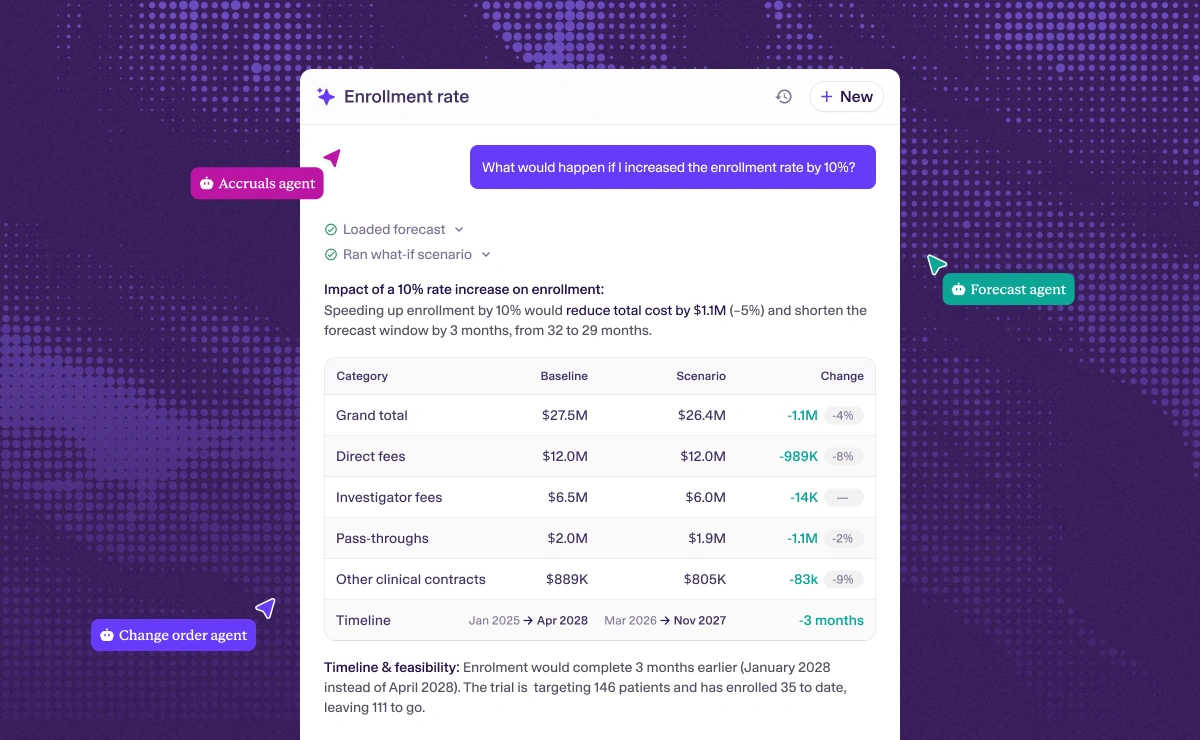
The last demo flipped the sequence altogether. Instead of waiting for a CRO's change order and then analyzing it, I modeled the scope change myself, before any document arrived, directly in Condor's production environment. I typed a plain-language prompt asking the system to forecast a scenario for the study: expand from seven to 11 sites, keep the 48-month duration and hold patient counts flat, then show the incremental cost against the current $10.67 million contract value.
Condor's forecasting agent built that scenario in real time, referencing the study's actual contract structure and cost drivers, and landed on a $629,000 incremental increase. Compare that to the $2 million-plus the CRO's change order was requesting for the same scope, and the gap tells you everything: once you strip out costs that shouldn't move when patient volume doesn't (like a big chunk of that monitoring spend), the real cost of the change is a fraction of what was billed. That's the value of scenario planning: you walk into the negotiation with your own independent number already in hand, instead of reacting to whatever number the CRO sends first.
Here’s the webinar recording.
We’ve trimmed the Talon and Condor demos from it. Want to see all the demos, and see what this looks like with your own data? Book a demo with our team here.
What's Next in the Series
As I mentioned, this is the second of several webinars and workshops in our Practical Applications of AI in Clinical Finance & Ops series. We polled attendees live during the webinar on what they wanted to see next, and the results were clear. Here are a few of the topics we’ll cover:
- Monitoring vendor spend pacing against contract value and identifying anomalies in vendor invoices (the top pick)
- Building a first trial budget from a protocol
- Building an AI prompt library for your clinical finance team
We'll be running these both as webinars and as in-person live workshops at upcoming industry events, where you can bring your laptop and work through the exercises with us in real time. Stay tuned for updates!