Best Clinical Trial Accruals Software: A Plain-English Guide for Pharma Finance Teams


Key takeaways
If you work in pharma finance, you already know how painful clinical trial accruals can be. Every quarter, your team is hunting down CRO status reports, updating spreadsheet models, chasing vendors for activity data, and trying to make sure the numbers hold up under audit — all while managing a dozen other priorities.
Most pharma companies still do this the hard way: manually, in Excel, with a lot of back-and-forth emails and a lot of crossed fingers. But there's a growing category of software built specifically to fix this problem.
This guide walks through what clinical trial accruals software does, what separates the good tools from the mediocre ones, and how the major vendors compare. Whether you're evaluating options for the first time or trying to replace a clunky legacy setup, this should help you get oriented quickly.
What Are Clinical Trial Accruals — and Why Do They Matter?
Here's the basic idea: when you run a clinical trial, you're paying vendors — CROs, investigator sites, labs, imaging centers, and others — over a long period of time. But those vendors don't always bill you right when the work happens. They might send invoices weeks or months later.
Accruals are how your finance team accounts for money that's been spent (or is owed) even before an invoice shows up. Under GAAP, you have to record expenses when they're incurred — not when you get the bill. For public companies, this is also a SOX requirement, meaning auditors will scrutinize your methodology closely.
In practice, that means your accounting team has to estimate, every single month or quarter, what work has been completed and what it costs. That includes:
- Pulling activity data from your CROs, study sites, and clinical systems (like EDC and IRT platforms)
- Estimating how far along each service category is — direct fees, pass-throughs, investigator grants
- Reconciling those estimates against your contracts, including any change orders or amendments
- Accounting for currency differences if you're running global studies
- Producing journal entries and documentation that auditors can actually follow
- Doing all of this repeatedly, across every active trial, every single period
A single Phase 2 or Phase 3 trial can involve $50M to $500M in vendor spend. Getting accruals wrong in either direction — too high or too low — can misstate your financials and create serious problems at audit time.
The core problem: Clinical trials don't follow clean billing cycles. A CRO might send a monthly summary weeks after the period ends. Sites submit expenses on their own schedule. Protocol changes can shift costs mid-stream. Your finance team has to turn all of that into accurate, period-specific estimates — month after month, for every trial on your plate.
Why Spreadsheets and Manual Processes Don't Cut It Anymore
A lot of pharma finance teams — even ones running late-stage trials — are still doing accruals by hand. They've built elaborate Excel models, they chase CRO contacts for status updates, and they manually reconcile everything before close. It works, sort of. But it has some serious downsides.
1. You're always working with old data
When your accruals are built on delayed invoices or CRO reports that arrive two weeks after the period ends, your numbers are always behind. By the time finance has a complete picture, the trial has moved on. There's no good way to see what's actually happening right now.
2. It eats up your best people's time
Building accruals from scratch every period is slow. Senior accounting staff spend days pulling data, updating models, and chasing down approvals — work that should take hours. That leaves almost no time for anything more strategic.
3. Everything is siloed
Clinical data lives in one system. Contracts and change orders live in another. Financial actuals are in your ERP. None of these talk to each other automatically. So when a protocol amendment happens or a CRO submits a change order, someone on your team has to manually figure out what that means for the financials.
4. Your forecasts go stale fast
A static spreadsheet model can't keep up with what's actually happening in a trial. When enrollment slows down or a vendor changes scope, updating the forecast means rebuilding parts of the model from scratch. By the time you're done, something else has changed. Finance ends up reactive instead of ahead of problems.
По цифрам (в оригинале — три стат-карточки; в блоге можно дать строкой или списком):
- 70–75% — Efficiency gain. Reported by biopharma teams using purpose-built accruals software
- 90%+ — Forecast accuracy. Achievable with automated, data-connected accrual platforms
- >30% — Vendor budget savings. Average per trial with proactive financial management
What Good Clinical Trial Accruals Software Should Actually Do
Not all tools are built the same. Some are purpose-built for pharma accruals. Others are general finance platforms that teams try to adapt. Here are the six things that actually matter when you're evaluating options:
1. It should connect to your clinical data automatically
The whole point of software is to stop manually gathering data. Look for tools that pull directly from the systems your clinical teams already use — Medidata, Veeva, Suvoda, your CTMS — so you're not uploading spreadsheets or waiting on CRO portal exports. If it requires manual data entry, you haven't actually solved the problem.
2. It needs to understand how pharma contracts actually work
Clinical trial contracts are complicated. They have fixed fees, pass-throughs, investigator grants, milestones, and change orders — all in different currencies, across different vendors. Your accruals tool needs to handle all of that natively, not require you to build custom formulas on top of a generic finance platform.
3. Forecasting should be built in, not bolted on
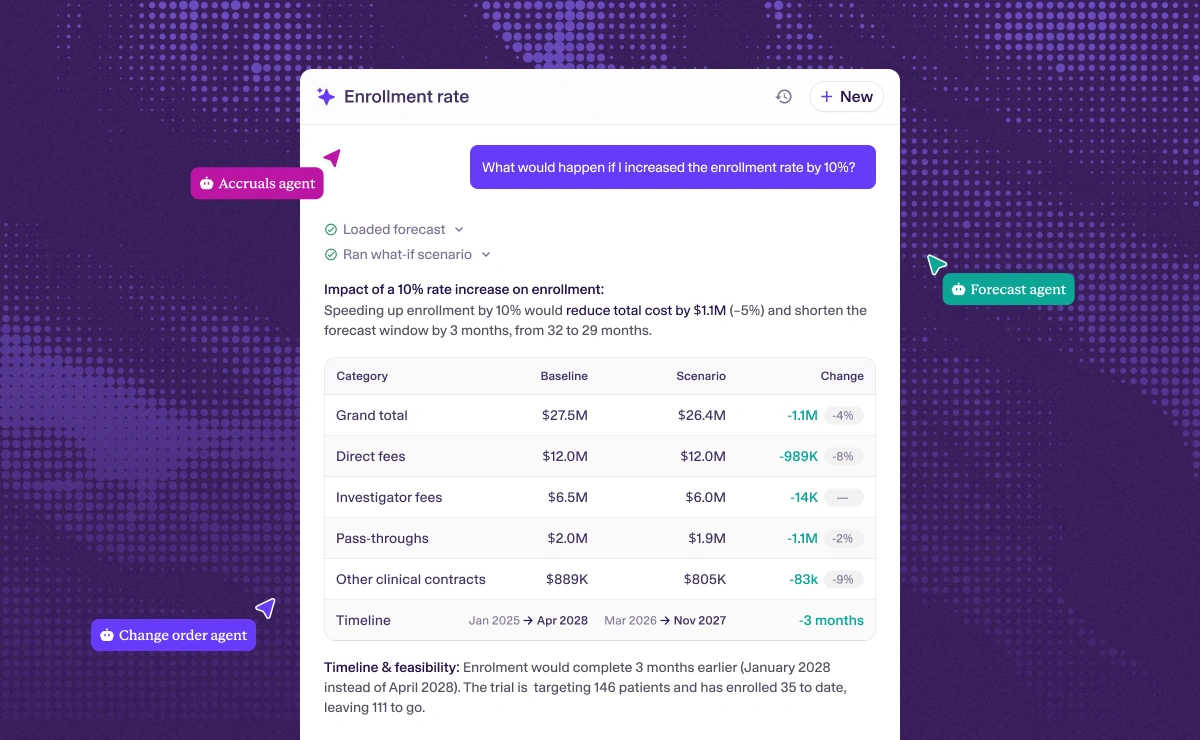
The best tools use the same data for accruals and forecasting. That way, when actuals come in, your rolling forecast updates automatically. You should be able to model "what if enrollment is 20% slower?" or "what if this amendment goes through?" without rebuilding your model from scratch.
4. Auditors need to be able to follow everything
For public companies and pre-IPO biotechs, SOX compliance is a real concern. Every calculation needs to be traceable and documented. Look for tools with full audit trails, role-based access controls, and ideally SOC 1 or SOC 2 certification. Bonus points if the tool was designed with Big 4 audit requirements in mind.
5. It should plug into your existing ERP and finance tools
Accruals end up as journal entries in your general ledger. Your tool needs to integrate cleanly with your ERP — whether that's SAP, Oracle NetSuite, or Sage — so you're not manually rekeying data. Integration with FP&A platforms like Anaplan, Planful, or Adaptive Insights matters too if you're running separate planning workflows.
6. It should scale as you add more trials
A tool that works fine for two trials should still work when you have fifteen. Look for portfolio-level dashboards, multi-entity support, and the ability to handle more volume without proportionally increasing your team's workload.
The Top Clinical Trial Accruals Software Tools
Here's an honest look at the tools pharma finance teams most commonly evaluate — including purpose-built platforms, clinical data systems, ERP tools, and yes, Excel. Some of these are genuinely built for accruals. Others are tools that teams try to stretch to fit the use case. It's worth knowing the difference before you start demo calls.
Condor Software — Purpose-Built · Biopharma
Condor is built specifically for pharma R&D finance — not adapted from a general accounting tool. It automates clinical trial accruals, forecasting, budgeting, and benchmarking. The platform pulls data directly from clinical systems your team already uses (Medidata, Veeva, Suvoda) and connects to your ERP and FP&A tools through its Condor Connect integration layer. The result: your accruals are based on live activity data, not lagging invoices or manual estimates. Finance teams using Condor report closing 60% faster and achieving 90%+ forecast accuracy without growing headcount.
Strengths:
- Native clinical data integrations (EDC, IRT, CTMS)
- Purpose-built accrual engine for biopharma contracts
- 90%+ forecast accuracy, 70–75% efficiency gains
- SOX/SOC-compliant, audit-ready workflows
- Scales from 2 trials to 20+ without headcount growth
- Big 4–trusted outputs
Considerations:
- Focused on biopharma — not a general-purpose finance tool
- Best fit for companies with active clinical programs
Clario (formerly BioClinica) — Enterprise CRO Services
Clario is primarily a clinical services and data capture company — they do endpoint adjudication, eClinical technology, and imaging. Some sponsors using Clario as a CRO get access to spend-tracking portals, but these are built for Clario's own team to manage, not for sponsor-side accounting. If you're looking for a tool to run your own accruals, this isn't it.
Strengths:
- Deep clinical data capabilities
- Established enterprise relationships
Considerations:
- Not a finance/accounting platform
- CRO-side reporting, not sponsor-side accrual automation
- Limited ERP or FP&A integration
Veeva Vault eTMF / CTMS — Clinical Operations Platform
Veeva is the dominant clinical operations platform in pharma — eTMF, CTMS, EDC, and regulatory are all in their suite. It's widely used and holds a lot of the site-level data that feeds into good accrual estimates. But Veeva doesn't calculate your accruals. Think of it as a data source that should connect into a financial platform, not a replacement for one.
Strengths:
- Comprehensive clinical data repository
- Industry-standard in mid-to-large biopharma
- Good API connectivity for downstream finance tools
Considerations:
- Not an accruals or finance platform
- Requires integration with a financial layer for accruals
- High cost and implementation complexity
SAP / Oracle NetSuite / Sage (ERP) — ERP General Ledger
Your ERP is where accruals land as journal entries — it's not where they get calculated. SAP, NetSuite, and Sage are great at what they do, but none of them understand how a CRO contract works. They don't know what investigator fee structures look like or how to handle percent completion across service categories. Companies that try to run clinical accruals directly in their ERP almost always end up layering Excel on top of it anyway — which defeats the purpose.
Strengths:
- System of record for GL and financial reporting
- Strong SOX and audit controls natively
- Already in place at most companies
Considerations:
- No clinical-specific accrual calculation logic
- Requires extensive customization for biopharma use cases
- Acts as destination, not source-of-truth for accruals
Microsoft Excel (Manual Accrual Models) — Spreadsheet-Based
Most pharma finance teams reading this are still using Excel for at least part of their accrual process — and that's fine for one or two trials. But Excel doesn't connect to live clinical data. It has no audit trail. Formulas break. Models get inherited from people who've left the company. And as your trial count grows, the amount of time your team spends maintaining these models grows right along with it. Every other tool on this list should be measured against what it would take to just keep doing things in Excel.
Strengths:
- Universally available, no procurement required
- Fully flexible for any model structure
- Finance teams know it well
Considerations:
- No live data connections — fully manual input
- High error risk; no audit trail
- Does not scale beyond 3–4 concurrent trials
- Cannot support SOX compliance requirements
- Enormous opportunity cost on senior finance staff time
Anaplan / Planful / Adaptive Insights — FP&A / Planning Platforms
Tools like Anaplan, Planful, and Workday Adaptive Insights are widely used by pharma finance for budgeting, planning, and rolling forecasts. Some teams try to build accrual models inside these platforms. The problem: they're not built for clinical contract logic. They don't have native connections to EDC or IRT systems. You'd need to custom-build everything, and it still won't be as accurate as a tool designed specifically for this. They're better used as the downstream home for accrual data than as the engine that produces it.
Strengths:
- Powerful scenario planning and modeling
- Strong financial consolidation capabilities
- Good integration with ERP systems
Considerations:
- Not built for clinical accrual calculation logic
- No native clinical data (EDC, IRT) connectors
- Significant custom build required for R&D use cases
LedgerRun — Clinical Finance
LedgerRun is one of the purpose-built clinical trial finance tools in the market. It handles CRO accruals, contract management, and financial tracking for biopharma. It's generally a good fit for smaller biotech teams looking for something more structured than Excel without a heavy enterprise implementation. Forecasting and benchmarking capabilities are more limited compared to newer platforms, but for teams just starting to move off spreadsheets, it's a reasonable option to evaluate.
Strengths:
- Purpose-built for clinical trial finance
- Relatively fast to implement
- Accessible for smaller biotech teams
Considerations:
- Limited AI/ML-driven capabilities
- Less robust forecasting and benchmarking
- Fewer integrations compared to newer platforms
Medidata (a Dassault Systèmes company) — Clinical Data Platform
Medidata is the industry standard for clinical data capture — EDC (Rave), IRT, and increasingly AI-powered trial analytics. Like Veeva, it holds a huge amount of the patient and site activity data you'd want driving your accrual estimates. But Medidata doesn't do sponsor-side financial accounting. It's the source of the data, not the tool that turns that data into journal entries. You still need something else to close your books.
Strengths:
- Gold standard for clinical data capture
- Extensive data for driving accrual estimates
- Broad industry adoption
Considerations:
- Not a finance or accruals platform
- Expensive; complex implementation
- Finance teams still need a separate accrual system
How They Compare Side by Side
[EMBED: comparison-table]
Questions to Ask Before You Buy
Before you book demos or send out an RFP, get your internal team aligned on what actually matters. The Controller, VP FP&A, and whoever owns clinical finance should all be in the room — they care about different things, and you'll want to surface those differences before a vendor does.
Things you need the tool to do
- Connects directly to our ERP (know which one)
- SOC 1 Type II or SOC 2 Type II certified
- Handles our CRO contract types (fixed-fee, FTE, milestone)
- Automates investigator fee and grant calculations
- Handles multiple currencies and FX automatically
- Full audit trail for every number and journal entry
- Different access levels for accounting, clinical, and FP&A
- We can be up and running in 8–12 weeks
Things that separate the good tools from the great ones
- Live data from EDC/IRT (not just file uploads)
- Rolling forecast uses the same data as accruals
- Can model "what if enrollment slows" scenarios easily
- Can benchmark costs across trials
- Flags variances automatically instead of relying on manual review
- References from companies at a similar stage to ours
- Connects to our FP&A tool (Anaplan, Adaptive, Planful)
- Designed for regulated environments with a validated release process
One thing most teams skip: ask each vendor to walk through a full close cycle using data from a trial that looks like yours. Generic product demos are easy to polish. What you want to see is how the tool handles a messy change order, a mid-period protocol amendment, or a site that's billing late. Bring your Controller and your most complicated CRO contract to that call.
Why Condor Was Built for This
Condor was started because the people who built it had been on the finance side of pharma companies and knew firsthand what a mess clinical trial accruals could be. No existing tool — not the ERP, not the FP&A platform, not the spreadsheet — actually spoke the language of clinical contracts. So they built something that did.
The Condor Platform — three modules that work together as a single financial system for pharma R&D. Each one handles a different piece of the problem — and they share the same underlying data, so nothing falls through the cracks: Connect (Data Integration), Copilot (Workflow Automation), Compass (Intelligence & Benchmarking).
Condor Connect pulls data automatically from the systems your clinical teams already use — Medidata, Veeva, Suvoda, IQVIA, Labcorp, ICON, PPD, Worldwide Clinical Trials, and others — and syncs with your ERP and FP&A platforms. No file uploads, no waiting on CRO portals, no manual reconciliation to get data flowing.
Condor Copilot runs the accrual calculations: applying your contract structures, figuring out percent completion by service category, computing investigator fees and grants, handling currency, building journal entries, and generating the documentation your auditors need to sign off. Finance teams using Copilot report cutting their close time by 60% and reducing the team hours spent on accruals by 70–75%.
Condor Compass takes the data further — connecting clinical and financial information across your full trial portfolio so you can benchmark costs, spot overruns early, and model out long-range scenarios. It's the difference between reporting on what happened and actually steering where things are going.
The platform has been validated by Big 4 auditors and is built with SOX compliance at its core. Customers have gone from managing 2 trials to 10 without adding headcount — and have found more than $5M in savings on individual programs by catching accrual discrepancies and change order exposures before they became problems.
How to Pick the Right Tool
The good news: you have real options now. A few years ago, the honest answer for most pharma finance teams was "use Excel and hope for the best." Today there are tools built specifically to solve this problem, and the case for switching is pretty clear.
If you're running more than two or three active trials — or you know you will be soon — the time and error cost of manual accruals is almost certainly higher than the cost of a purpose-built platform. The finance teams that move first don't just close faster; they get visibility that actually helps with budget decisions and audit prep.
When you evaluate tools, keep the focus on three things: does it connect to your clinical data automatically, does it actually understand how pharma contracts work, and can your auditors follow every number it produces? Everything else is secondary.
The best clinical trial accruals software isn't the one with the longest feature list. It's the one that makes close week less painful, keeps your forecasts accurate, and lets your team spend time on things that actually matter.