
Jen Kyle
CEO and Founder, Condor
Articles
Introducing the World’s First Clinical Finance AI Agent Purpose-Built for Biopharma
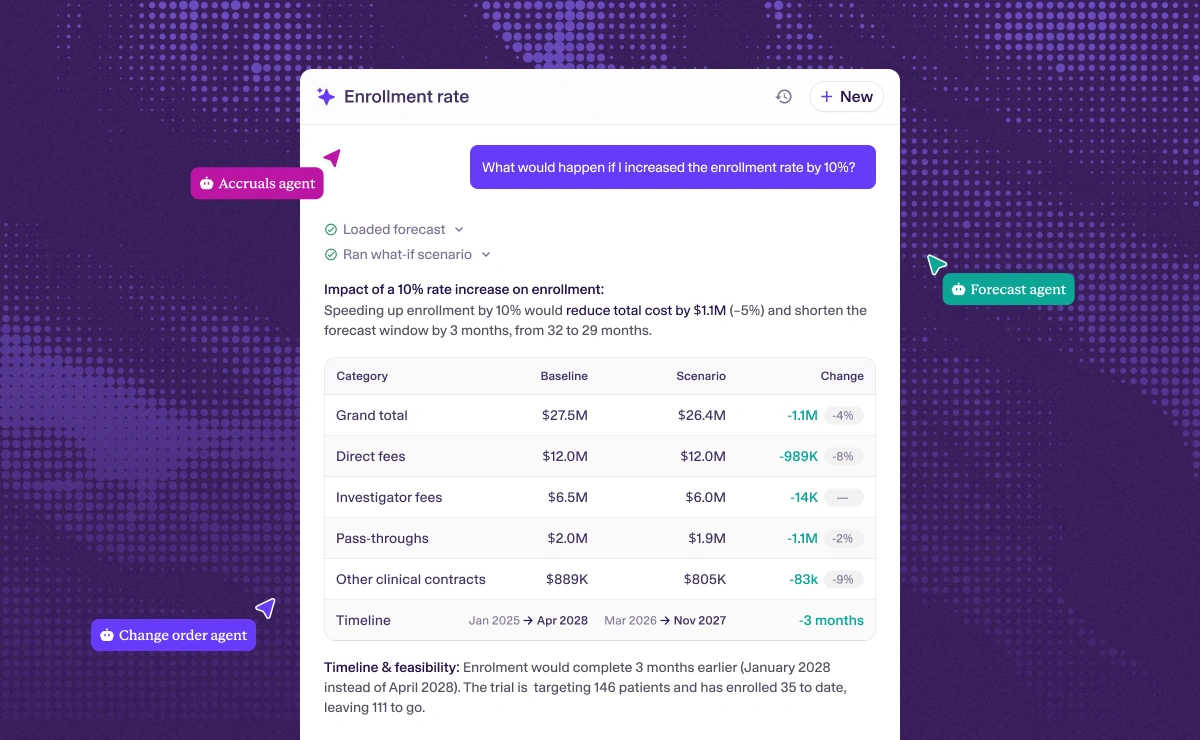
Today we unveiled Condor's Clinical Finance AI Agent — the world's first AI agent purpose-built for biopharma R&D finance.
Ask it why a trial's actuals and forecast diverged, and it reasons across your full budget and forecast history to give you the answer in seconds, not the days it takes to reconcile across your ERP, CTMS, EDC, and a dozen spreadsheets. Ask it what a change in site mix or enrollment timing will cost you, and it runs the scenario and builds the resulting model directly in Condor. It doesn't just surface a number. It gives you the "why," and then it does the work.
This is a big milestone for our company and industry. It's also the moment I've been building toward since the day I started Condor.
The vision I had five years ago
When I founded Condor, I believed the financial machinery underneath every clinical trial could be fully automated, end-to-end, with AI reasoning on top of it.
No more manually managing or outsourcing your finances. The numbers, built by an engine you can trust. Workflows run by AI. The why behind the numbers, uncovered in seconds instead of weeks, while there’s still time to act.
Our new agent is the realization of that vision.
Why it took five years
Building AI that produces numbers you can actually trust is unbelievably hard.
It took building Condor's financial engine first — a deterministic layer that follows defined rules, produces consistent output every time, and is fully auditable. No guessing, no black box, no "the model thinks it's probably right." Every number has to tie back to the clinical activity that actually drove it, because in this industry, a number nobody can defend is a number nobody will use.
It took building a knowledge graph grounded in a clinical and financial ontology we developed over years of work with Big 4 accounting firms — mapping how budgets, vendor contracts, clinical sites, and clinical activity actually connect to each other, across hundreds of studies and therapeutic areas. That ontology is what lets our agents understand a change order or a forecast variance the way a clinical finance team does, instead of the way a generic model guesses.
We built all of that first, five years ago, before there was a market pulling us to do it, because we knew it was the only foundation AI could stand on and still be trusted with a number that ends up in a board deck.
Recently, competitors that built their entire business model around outsourcing clinical finance — putting bodies behind the work instead of automating it — have realized AI is where our industry is headed. They're years behind, so the best they can offer is AI bolted on top of their services model.
Layering AI onto a services model doesn't change what the AI is standing on. If the underlying data was never built for automation — if it was always meant to be assembled by a person — AI on top of it can move faster, but it can't reason with the same grounding as our AI platform. It will take those companies years to build what we have been building for the last five years, because an ontology and a knowledge graph like ours can't be retrofitted. They have to be the starting point.
Why our AI platform matters now, more than ever
For most of the last century, science was the bottleneck in drug development. AI is closing that gap fast, and pipelines are about to fill with more candidates than this industry has ever had to fund at once. Every one of those candidates still has to be forecasted, funded, and managed. Right now, the financial infrastructure doing that job is still, for almost everyone, a spreadsheet.
The bottleneck didn't disappear. It moved from the lab to the ledger. Today, Condor is the only platform built from the ground up to run biopharma R&D finance and operations at the scale AI-driven pipelines are about to demand. Because we built the engine, then the knowledge graph, then the agents, in that order, on purpose.
What comes next
Our Clinical Finance Agent is one of a growing team of agents built on Condor's knowledge graph. Each one, including our forthcoming investigator grant agent, is purpose-built to remove a specific piece of manual work slowing R&D finance and clinical operations teams down.
My vision is here: No more manually managing your finances. The numbers built by our engine. The workflows run by AI. The why behind the numbers uncovered in seconds, not weeks, while there’s still time to act.
This is the start of something big for our industry.
If you want to see the agent for yourself, book a demo.
Read the article

How Condor is Building the Financial Intelligence Layer for Life Sciences
Condor has doubled in size since closing our $24 million Series A funding round in March. A lot of that investment is going into expanding our engineering team. The reason is simple: What we’re building at Condor is truly unique and has the power to transform life sciences R&D. Our Financial Intelligence Layer is powered by a knowledge graph and clinical and financial ontology that we developed over years with Big 4 accounting firms, giving life sciences R&D teams trustworthy data that empowers them to operate with confidence and bring therapies to patients faster and more cost effectively.
Having the best engineering team in the world isn’t a nice to have; it’s a must have. That’s why we’ve been obsessed with making our impressive engineering team even better.
Building the R&D infrastructure that all life sciences companies rely on
Jay Tailor recently joined Condor as VP of Engineering with 18 years experience building and scaling complex AI, data, and ML systems. The work he’s doing with the engineering team is critical to us delivering our clinical finance AI agents later this year.
He spent nearly a decade at Unity Technologies, where he rose from engineering lead to director. During that time, he built the company's centralized data platform from the ground up (a streaming system that grew into critical infrastructure for the business, processing billions of events a day to power monetization and analytics); scaled teams from a handful of engineers to more than 60 people across AI, data, ML, and cloud; transitioned the platform to modern stream based processing; and partnered with Google for nearly two years to build machine learning infrastructure at a scale that most engineers never encounter.
I asked him why he left gaming for biopharma. He said: “A lot of AI companies right now are building generative tools. That's fine, but the field where AI is going to have the most transformative impact is life sciences and biopharma. I want Condor to be the Stripe of biopharma. The infrastructure that every top pharma and biotech company in the world relies on for their financial intelligence. The thing where there's no real alternative because Condor is just that good. That's what we’re all building toward.”
AI as a foundation, not a feature
To do that, AI can’t be a bolt on. At Condor, everything a customer touches — from onboarding, to exploring their data, to understanding why a number changed, to seeing what's really happening across a trial — is intelligent by default. Jay says, "We are incorporating AI into our Financial Intelligence Layer in a way that makes you stop and think, how did we ever do this without Condor?"
That same conviction runs through how the team works. AI is embedded across the full development lifecycle. That enables engineers to spend their time on the hard, high-value problems that actually move the mission forward.
The engineering team we're building
We're looking for engineers who are driven to solve hard problems at the intersection of data and AI. In particular, people who bring:
- Deep data experience — building and scaling data platforms, pipelines, and systems where accuracy and trust are non-negotiable.
- Strong backend engineering — designing services and architectures built to scale, with a high bar for craft and reliability.
- Production AI-agent experience — not demos or prototypes, but AI agents shipped into real production environments, solving real problems for real users.
- FDE (Forward Deployed Engineer) – hybrid software engineer, technical consultant, and product manager. They embed directly with customers, usually on-site, to implement, customize, and troubleshoot technical platforms (especially AI and LLM products)
Beyond the technical requirements, we also look for a particular mindset: someone who moves fast, but builds things that last. It takes a deep love of the craft to build something extraordinary. Someone who is energized by real stakes since our infrastructure helps get medicines to patients faster. Someone who wants AI to be part of how they work every day. And above all, someone who is curious: they want to know why we're building something, who we're building it for, and what their paint points are.
Our culture reflects that. We move with urgency, because we have a real window to define this category. We hold a high bar for quality and craft. We start from the customer's real problem; not the feature request. A culture where wins are shared and celebrated.
If that resonates, we're hiring. Learn more here.
Read the article

Generic AI isn’t Good Enough for Clinical Trial Finance. Here’s Why.
This is part 3 of a series on How to successfully implement AI. Part 1 covered what AI is. Part 2 covered how Condor uses AI to produce numbers you can trust. This one covers why generic AI can’t do clinical trial finance.
Finance teams across biopharma are connecting ChatGPT and Claude to their clinical trial data and asking for accruals, variance explanations, and spend forecasts. Generic AI is excellent at conversational finance work: synthesizing documents, drafting memos, ad hoc analysis, and finance teams should be using it today.
But as many companies are finding out, building an AI interface is easy. The hard part is the underlying context engineering, validation, domain expertise, and operational understanding required to make outputs trustworthy and actionable.
Clinical trial finance is a reasoning problem over a structured system of record, and generic AI lacks the architecture required to reason reliably over that system.
That’s because generic AI wasn’t purpose-built for the complexity of clinical trial finance. As a result, it often produces inconsistent results on subjective estimates (aka clinical accruals). Here are the three reasons why generic AI isn't precise enough for clinical trial finance, and what the right architecture looks like.
1. It doesn’t understand the business of clinical R&D
As finance leaders, we know a simple truth: before you can understand the finances, you must understand the business. Generic AI is no different.
Every number depends on protocols, patient enrollment, site activity, vendor contracts, change orders, milestones, pass-through costs, and accounting policies. To understand the financial outcome, you first need to understand the operational reality driving it.
Generic AI reasons over text. It does not understand how your trial operates, or have the necessary domain context. Clinical trial finance is a relational problem — a web of interdependent contracts, protocol events, accounting rules, and cost structures that must all align before a number is trustworthy.
You can add specific business and clinical context to help your analysis. But as you read below, you’ll see that’s not enough. This is why standard accounting reconciliation processes are good candidates for generic AI, but they can be dangerous when used for a deeply specialized and industry-specific workflow.
For example, if you ask it what "pass-through costs" are, it will know the dictionary definition, and it might be able to make a guess on how it applies. It doesn’t know the nuances within the pass-through costs, why they’ve been contracted, what it means to the clinical trial itself, and what operational drivers affect those costs.
Generic AI will also understand clinical accruals or forecasting very broadly. But you’ll have to spend a lot of time engineering the context to understand what happens on a given protocol, what the assessments are, why they matter, the logic behind visits in the EDC, what the CROs are contractually doing, what the different imaging vendors are doing, and the inflection points you're executing against.
Let’s say you initially engineer this context and map it to your business. Your model will still drift without grounding.
2. It has no grounding, so it hallucinates and drifts
After the context, the next hurdle is grounding and drift.
A hallucination is when generic AI generates information that is factually incorrect, fabricated, or nonsensical, but presents it with apparent confidence, as if it were true. For example, the analysis tells you “The CRO amendment increased costs by $2.3M”, but no amendment exists. Hallucinations aren’t a bug that gets fixed. They’re a structural property of how generic AI works. It has no mechanism to check whether what it's saying is true. And that's a gap.
Drift is another problem. It’s gradual degradation or shift in an AI model's performance, behavior, or outputs over time. The answer can sound perfectly reasonable, use real information, and still solve the wrong problem. For example, the analysis started answering your question, "How much cash do we need to reach the last patient dosed?", and 10 steps later it’s optimizing the study timeline rather than answering the cash requirement question. The numbers may be real. The model is just solving the wrong problem.
Both failures stem from the same issue: the model has no source of truth. Grounding is what closes this gap.
Your enrollment and site administration lives in clinical systems, contracts in executed agreements live in multiple systems, your budget and forecast may live in different systems or on a spreadsheet — none sharing a data model. They need to share a data model and know how to relate with one another in order to be precise and effective. This is what enables the lineage (or audit trail described below).
A grounded system ties every claim to a structured source of truth: an ontology defining what entities exist, a knowledge graph defining how they relate, and deterministic rules the output must satisfy before providing probabilistic results.
Generic AI has none of this. Working from a flat export, the model has no way to know what it doesn't know. The result is confident, specific, and unverifiable (or unauditable). In a regulated industry that needs reliability, consistency and accuracy, that’s a very dangerous kind of wrong.
3. It’s missing lineage (aka audit trail): It can't explain where the answer came from
Here's the ultimate test: ask any AI system to show its work; not just the answer. Show the exact contracts, enrollment data, site activity, assumptions, accounting policies, and calculations that produced the number. Show how they relate to one another. Show what changed since last month. Show what drove the variance.
Generic AI can't do this.
Even when it produces the correct answer, it cannot reliably explain the chain of reasoning that led there. Its outputs are generated through statistical inference, not a documented chain of evidence. There is no persistent record connecting the underlying clinical and financial data to the final result.
This becomes a major problem in clinical trial finance because trust isn't created by the number itself. Trust comes from understanding how the number was produced.
Every accrual, forecast, and scenario depends on hundreds of interconnected assumptions across protocols, contracts, enrollment, site activity, vendor spend, accounting policy, and financial controls. If you cannot trace the output back through those relationships, you cannot validate it, defend it, or audit it.
This is where lineage becomes essential.
Lineage creates a complete chain of custody from source data to financial outcome. It shows which systems were used, how the data was mapped, which business rules were applied, what assumptions were made, and how every calculation was derived. When an executive asks a question, the answer isn't simply generated — it is supported.
In regulated industries, explainability isn't optional. Auditors require it, controllers depend on it, and regulators expect it. And finance leaders need it before they can trust AI with material decisions.
Without lineage, AI produces answers. With lineage, AI produces evidence.
What the right architecture looks like
Condor was built to solve exactly these three problems.
Domain context is built in. Condor was designed specifically for clinical trial finance, with years of clinical and financial knowledge embedded into its foundation. Condor's platform is built on proprietary clinical and financial ontologies that understand the relationships between protocols, enrollment, site activity, vendor contracts, budgets, forecasts, and accounting rules because those relationships are native to the system; not added later through prompts or manual configuration. These ontologies were developed over years with Big 4 accounting firms; not configured after the fact, but architected into the foundation. When Condor calculates an accrual, it is applying rules that reflect how clinical trial finance actually works.
Grounding mitigates hallucination and drift. The knowledge graph in Condor continuously connects your live clinical, operational and financial data across the systems biopharma companies already use — CTMS, EDC, IVRS, CRO contracts — to a structured model of how that data relates to financial obligations. There is no gap-filling. When enrollment changes, sites activate, milestones are achieved, or change orders are approved, the financial impact is reflected automatically. The platform isn't inferring what happened. It understands what happened and how it affects the forecast, accrual, and budget. The AI reasons against a ground truth it can prove.
Every number is explainable and comes with an audit trail. Finance teams can trace results back to the underlying contracts, operational activities, assumptions, and accounting rules that produced them. The platform doesn't just provide an answer; it provides the evidence behind the answer.
The difference between generic AI and a purpose-built clinical financial intelligence platform isn't a feature gap. It's an architecture gap. One was designed to generate plausible answers. The other was designed to produce numbers you can prove and explain.
In clinical trial finance, that distinction matters. It determines whether forecasts are credible, whether accruals are defensible, whether auditors can validate the process, and ultimately whether management teams have the confidence to make the right business decisions.
The good news is that these technologies are complementary. Generic AI is excellent for research, analysis, and productivity. Purpose-built clinical financial intelligence platforms provide the trusted data and operational foundation those tools need to be effective so they can operate with confidence and bring therapies to patients faster and more cost effectively.
Condor can help you elevate your R&D finance function into an AI-native one by enriching your generic AI with domain context, grounding it to prevent hallucinations and drift, and creating an audit trail. Schedule some time with our experts to learn more.
Condor is the Financial Intelligence Platform for life sciences R&D. Learn more at condorsoftware.com.
Read the article

What We Heard at ABFO 2026: AI Is the Priority — and Many Don’t Know Where to Start
We recently returned from ABFO's National Conference in Philadelphia, where Condor was a proud sponsor and I had the privilege of hosting a panel on how to successfully implement and scale AI in clinical finance. I was joined by Phil Howard, Partner and Integrated Finance Managed Service Leader at EY; Allison Richards, Executive Director of FP&A at BridgeBio; Haiyang Hu, Senior Director of Finance at Addition Therapeutics; and Bobby Fuhrman, Executive Director of Finance at Atrium Therapeutics.
I want to start with a huge thank you to everyone who attended. We had standing room only. Clearly, AI is top of mind for the ABFO community right now.

I wanted to share the slides from our presentation along with a few key takeaways from the session — and from the conversations I had throughout the week. If you’re curious to learn more, join us for our webinar on June 16 from 10-11 am PT. We’ll go deeper on my slides from the session, and discuss where AI is and where it’s heading, how to balance innovation speed with the controls CFOs and auditors expect, and what the highest leverage teams are doing with AI right now.
Everyone Knows They Need AI. Many Don’t Know Where to Start.
The single biggest thing I heard — from the stage, in the hallways, at dinner — was this: I know we need to be doing something with AI. I just don't know what, or how, or who to call first.
One attendee raised his hand during our session and said his entire accounting team was asking for AI licenses and he didn't know where to begin. He's not alone. There's no blueprint yet. And that vacuum is exactly what we want to help fill.
During our panel, we walked through three levels of AI use case maturity:
- Level 1 — Ad hoc LLM use: individuals using ChatGPT or Claude on their own, disconnected from systems or data.
- Level 2 — Pockets of AI use cases: departments starting to deploy AI in specific workflows, but not yet connected across the organization.
- Level 3 — Shared context across the value chain: AI that spans clinical, finance, and operations — with an agentic layer orchestrating insights across the full R&D lifecycle.
When I asked the room how many people were operating at Level 3, nearly no one raised their hand - understandably. The vast majority are still in Levels 1 and trying to figure out how to tackle Level 2.
"AI Might Replace My Job" — A Healthy Fear, and Why I Think It's Actually Good News
The other thing I heard a lot was fear. Not paralyzing fear, but a healthy, motivating anxiety: Am I going to get replaced by this?
I want to be direct: I don't think AI will replace your job. But I do think people who know how to use AI will replace people who don't.
That's not a threat. It's a pattern we've seen play out with every transformational technology. The people who leaned into the change, got curious, and built new skills came out ahead. The ones who waited to be forced into it scrambled to catch up.
Here's how I think about it: one of the core beliefs we shared during our panel is that you can delegate tasks, but you cannot delegate judgment. AI can automate the work — reconciliations, forecasts, accrual support, variance analysis, reporting. But it can’t own accountability. It cannot read the room in a board meeting. It cannot make the call that requires knowing your company's risk tolerance, your pipeline's strategic priorities, or the relationship dynamics with your CRO.
The highest-leverage finance teams will use AI to get the manual work off their plates faster, and then spend more of their time doing the things only humans can do. That's not a smaller role. That's a bigger one.
If your organization hasn't started yet, start now. Buy the license. Let people experiment. The only way to build comfort with AI is to actually use it.
What's Next: A Series to Help You Get Started
At Condor, we believe part of our job is to help the broader R&D finance community navigate this transition. So we're building out a series of resources to help you move from "I need to figure out AI" to "I know exactly what to do next."
Here is the presentation we shared during our ABFO panel:
We've already published:
- Part 1: What AI Is and How It Actually Works — A plain-language primer for finance leaders who want to understand what's actually happening under the hood.
- Part 2: How Our Platform Uses AI to Produce Numbers You Can Trust — How Condor separates its deterministic financial engine from its AI layer, so you get the speed without the risk.
Coming up next: a more tactical post on how to actually get started with AI in your finance function, including the specific steps, the right sequence, and how to build momentum inside your organization.
If you were at ABFO and we connected — thank you! If you have questions about any of this, or want to talk through where your organization is on the AI maturity curve, I'd love to hear from you.
Read the article

How our platform uses AI, and produces numbers you can trust
This is part 2 of a series on How to successfully implement AI. Part 1 covered what AI is. This one covers something more important: Can you trust AI?
I was at an ABFO event in Boston recently, and someone asked: “How do you secure the data and prevent hallucinations?”
AI models don’t “know” things the way a system of record does. They predict. Most of the time, they’re right; sometimes they’re not. Even the best AI gets things wrong sometimes.
So the next question is: How do you build a system where AI errors don’t turn into misstatements and bad guidance?
Most AI tools in finance today plug an LLM directly into workflows and let it generate outputs—numbers, recommendations, summaries—without enough structure underneath.
That’s where most systems go wrong and things break. Because now the same system that can “guess” is also influencing decisions.
How Condor approaches it differently
First: We don’t mix the numbers and the interpretation
We separate two things that should never be mixed: the numbers and the interpretation of the numbers.
1. The numbers (deterministic) - This includes accruals, budget vs. actuals, and forecast rollups. These come from Condor’s financial engine; not AI. They follow defined rules, are consistent, and are auditable. No guessing.
2. The interpretation (AI) - AI sits on top of those numbers, and helps answer questions like:
- What changed?
- What looks off?
- What should I pay attention to?
It finds patterns, flags anomalies, and explains what’s happening. But it does NOT create the numbers. AI can’t corrupt your financials because it never owns them.
Second: humans stay in control
Inside Condor, AI doesn’t take action on its own. Any material output like adjusting a forecast, calculating an accrual, and reconciling a balance requires human review and approval.
AI drafts and you decide. And it’s always clear what’s AI-generated and what’s system-calculated.
Third: security is built in—not bolted on
We treat data security as architecture, not policy.
- Each customer’s data is isolated at the database level
- AI models don’t have direct access to your data
- Only the minimum data needed for a task is shared
- Sensitive data (like patient info) is tightly controlled
- Nothing is stored, reused, or used to train models
Everything is traceable, and every output can be audited.
What this means in practice
The system we’ve built at Condor mitigates AI errors. And when AI is wrong, it gets caught before it matters. That’s why accounting, FP&A, and clinical teams trust Condor to manage over $19B in R&D spend.
Read the article

Best Clinical Trial Accruals Software: A Plain-English Guide for Pharma Finance Teams
If you work in pharma finance, you already know how painful clinical trial accruals can be. Every quarter, your team is hunting down CRO status reports, updating spreadsheet models, chasing vendors for activity data, and trying to make sure the numbers hold up under audit — all while managing a dozen other priorities.
Most pharma companies still do this the hard way: manually, in Excel, with a lot of back-and-forth emails and a lot of crossed fingers. But there's a growing category of software built specifically to fix this problem.
This guide walks through what clinical trial accruals software does, what separates the good tools from the mediocre ones, and how the major vendors compare. Whether you're evaluating options for the first time or trying to replace a clunky legacy setup, this should help you get oriented quickly.
What Are Clinical Trial Accruals — and Why Do They Matter?
Here's the basic idea: when you run a clinical trial, you're paying vendors — CROs, investigator sites, labs, imaging centers, and others — over a long period of time. But those vendors don't always bill you right when the work happens. They might send invoices weeks or months later.
Accruals are how your finance team accounts for money that's been spent (or is owed) even before an invoice shows up. Under GAAP, you have to record expenses when they're incurred — not when you get the bill. For public companies, this is also a SOX requirement, meaning auditors will scrutinize your methodology closely.
In practice, that means your accounting team has to estimate, every single month or quarter, what work has been completed and what it costs. That includes:
- Pulling activity data from your CROs, study sites, and clinical systems (like EDC and IRT platforms)
- Estimating how far along each service category is — direct fees, pass-throughs, investigator grants
- Reconciling those estimates against your contracts, including any change orders or amendments
- Accounting for currency differences if you're running global studies
- Producing journal entries and documentation that auditors can actually follow
- Doing all of this repeatedly, across every active trial, every single period
A single Phase 2 or Phase 3 trial can involve $50M to $500M in vendor spend. Getting accruals wrong in either direction — too high or too low — can misstate your financials and create serious problems at audit time.
The core problem: Clinical trials don't follow clean billing cycles. A CRO might send a monthly summary weeks after the period ends. Sites submit expenses on their own schedule. Protocol changes can shift costs mid-stream. Your finance team has to turn all of that into accurate, period-specific estimates — month after month, for every trial on your plate.
Why Spreadsheets and Manual Processes Don't Cut It Anymore
A lot of pharma finance teams — even ones running late-stage trials — are still doing accruals by hand. They've built elaborate Excel models, they chase CRO contacts for status updates, and they manually reconcile everything before close. It works, sort of. But it has some serious downsides.
1. You're always working with old data
When your accruals are built on delayed invoices or CRO reports that arrive two weeks after the period ends, your numbers are always behind. By the time finance has a complete picture, the trial has moved on. There's no good way to see what's actually happening right now.
2. It eats up your best people's time
Building accruals from scratch every period is slow. Senior accounting staff spend days pulling data, updating models, and chasing down approvals — work that should take hours. That leaves almost no time for anything more strategic.
3. Everything is siloed
Clinical data lives in one system. Contracts and change orders live in another. Financial actuals are in your ERP. None of these talk to each other automatically. So when a protocol amendment happens or a CRO submits a change order, someone on your team has to manually figure out what that means for the financials.
4. Your forecasts go stale fast
A static spreadsheet model can't keep up with what's actually happening in a trial. When enrollment slows down or a vendor changes scope, updating the forecast means rebuilding parts of the model from scratch. By the time you're done, something else has changed. Finance ends up reactive instead of ahead of problems.
По цифрам (в оригинале — три стат-карточки; в блоге можно дать строкой или списком):
- 70–75% — Efficiency gain. Reported by biopharma teams using purpose-built accruals software
- 90%+ — Forecast accuracy. Achievable with automated, data-connected accrual platforms
- >30% — Vendor budget savings. Average per trial with proactive financial management
What Good Clinical Trial Accruals Software Should Actually Do
Not all tools are built the same. Some are purpose-built for pharma accruals. Others are general finance platforms that teams try to adapt. Here are the six things that actually matter when you're evaluating options:
1. It should connect to your clinical data automatically
The whole point of software is to stop manually gathering data. Look for tools that pull directly from the systems your clinical teams already use — Medidata, Veeva, Suvoda, your CTMS — so you're not uploading spreadsheets or waiting on CRO portal exports. If it requires manual data entry, you haven't actually solved the problem.
2. It needs to understand how pharma contracts actually work
Clinical trial contracts are complicated. They have fixed fees, pass-throughs, investigator grants, milestones, and change orders — all in different currencies, across different vendors. Your accruals tool needs to handle all of that natively, not require you to build custom formulas on top of a generic finance platform.
3. Forecasting should be built in, not bolted on
The best tools use the same data for accruals and forecasting. That way, when actuals come in, your rolling forecast updates automatically. You should be able to model "what if enrollment is 20% slower?" or "what if this amendment goes through?" without rebuilding your model from scratch.
4. Auditors need to be able to follow everything
For public companies and pre-IPO biotechs, SOX compliance is a real concern. Every calculation needs to be traceable and documented. Look for tools with full audit trails, role-based access controls, and ideally SOC 1 or SOC 2 certification. Bonus points if the tool was designed with Big 4 audit requirements in mind.
5. It should plug into your existing ERP and finance tools
Accruals end up as journal entries in your general ledger. Your tool needs to integrate cleanly with your ERP — whether that's SAP, Oracle NetSuite, or Sage — so you're not manually rekeying data. Integration with FP&A platforms like Anaplan, Planful, or Adaptive Insights matters too if you're running separate planning workflows.
6. It should scale as you add more trials
A tool that works fine for two trials should still work when you have fifteen. Look for portfolio-level dashboards, multi-entity support, and the ability to handle more volume without proportionally increasing your team's workload.
The Top Clinical Trial Accruals Software Tools
Here's an honest look at the tools pharma finance teams most commonly evaluate — including purpose-built platforms, clinical data systems, ERP tools, and yes, Excel. Some of these are genuinely built for accruals. Others are tools that teams try to stretch to fit the use case. It's worth knowing the difference before you start demo calls.
Condor Software — Purpose-Built · Biopharma
Condor is built specifically for pharma R&D finance — not adapted from a general accounting tool. It automates clinical trial accruals, forecasting, budgeting, and benchmarking. The platform pulls data directly from clinical systems your team already uses (Medidata, Veeva, Suvoda) and connects to your ERP and FP&A tools through its Condor Connect integration layer. The result: your accruals are based on live activity data, not lagging invoices or manual estimates. Finance teams using Condor report closing 60% faster and achieving 90%+ forecast accuracy without growing headcount.
Strengths:
- Native clinical data integrations (EDC, IRT, CTMS)
- Purpose-built accrual engine for biopharma contracts
- 90%+ forecast accuracy, 70–75% efficiency gains
- SOX/SOC-compliant, audit-ready workflows
- Scales from 2 trials to 20+ without headcount growth
- Big 4–trusted outputs
Considerations:
- Focused on biopharma — not a general-purpose finance tool
- Best fit for companies with active clinical programs
Clario (formerly BioClinica) — Enterprise CRO Services
Clario is primarily a clinical services and data capture company — they do endpoint adjudication, eClinical technology, and imaging. Some sponsors using Clario as a CRO get access to spend-tracking portals, but these are built for Clario's own team to manage, not for sponsor-side accounting. If you're looking for a tool to run your own accruals, this isn't it.
Strengths:
- Deep clinical data capabilities
- Established enterprise relationships
Considerations:
- Not a finance/accounting platform
- CRO-side reporting, not sponsor-side accrual automation
- Limited ERP or FP&A integration
Veeva Vault eTMF / CTMS — Clinical Operations Platform
Veeva is the dominant clinical operations platform in pharma — eTMF, CTMS, EDC, and regulatory are all in their suite. It's widely used and holds a lot of the site-level data that feeds into good accrual estimates. But Veeva doesn't calculate your accruals. Think of it as a data source that should connect into a financial platform, not a replacement for one.
Strengths:
- Comprehensive clinical data repository
- Industry-standard in mid-to-large biopharma
- Good API connectivity for downstream finance tools
Considerations:
- Not an accruals or finance platform
- Requires integration with a financial layer for accruals
- High cost and implementation complexity
SAP / Oracle NetSuite / Sage (ERP) — ERP General Ledger
Your ERP is where accruals land as journal entries — it's not where they get calculated. SAP, NetSuite, and Sage are great at what they do, but none of them understand how a CRO contract works. They don't know what investigator fee structures look like or how to handle percent completion across service categories. Companies that try to run clinical accruals directly in their ERP almost always end up layering Excel on top of it anyway — which defeats the purpose.
Strengths:
- System of record for GL and financial reporting
- Strong SOX and audit controls natively
- Already in place at most companies
Considerations:
- No clinical-specific accrual calculation logic
- Requires extensive customization for biopharma use cases
- Acts as destination, not source-of-truth for accruals
Microsoft Excel (Manual Accrual Models) — Spreadsheet-Based
Most pharma finance teams reading this are still using Excel for at least part of their accrual process — and that's fine for one or two trials. But Excel doesn't connect to live clinical data. It has no audit trail. Formulas break. Models get inherited from people who've left the company. And as your trial count grows, the amount of time your team spends maintaining these models grows right along with it. Every other tool on this list should be measured against what it would take to just keep doing things in Excel.
Strengths:
- Universally available, no procurement required
- Fully flexible for any model structure
- Finance teams know it well
Considerations:
- No live data connections — fully manual input
- High error risk; no audit trail
- Does not scale beyond 3–4 concurrent trials
- Cannot support SOX compliance requirements
- Enormous opportunity cost on senior finance staff time
Anaplan / Planful / Adaptive Insights — FP&A / Planning Platforms
Tools like Anaplan, Planful, and Workday Adaptive Insights are widely used by pharma finance for budgeting, planning, and rolling forecasts. Some teams try to build accrual models inside these platforms. The problem: they're not built for clinical contract logic. They don't have native connections to EDC or IRT systems. You'd need to custom-build everything, and it still won't be as accurate as a tool designed specifically for this. They're better used as the downstream home for accrual data than as the engine that produces it.
Strengths:
- Powerful scenario planning and modeling
- Strong financial consolidation capabilities
- Good integration with ERP systems
Considerations:
- Not built for clinical accrual calculation logic
- No native clinical data (EDC, IRT) connectors
- Significant custom build required for R&D use cases
LedgerRun — Clinical Finance
LedgerRun is one of the purpose-built clinical trial finance tools in the market. It handles CRO accruals, contract management, and financial tracking for biopharma. It's generally a good fit for smaller biotech teams looking for something more structured than Excel without a heavy enterprise implementation. Forecasting and benchmarking capabilities are more limited compared to newer platforms, but for teams just starting to move off spreadsheets, it's a reasonable option to evaluate.
Strengths:
- Purpose-built for clinical trial finance
- Relatively fast to implement
- Accessible for smaller biotech teams
Considerations:
- Limited AI/ML-driven capabilities
- Less robust forecasting and benchmarking
- Fewer integrations compared to newer platforms
Medidata (a Dassault Systèmes company) — Clinical Data Platform
Medidata is the industry standard for clinical data capture — EDC (Rave), IRT, and increasingly AI-powered trial analytics. Like Veeva, it holds a huge amount of the patient and site activity data you'd want driving your accrual estimates. But Medidata doesn't do sponsor-side financial accounting. It's the source of the data, not the tool that turns that data into journal entries. You still need something else to close your books.
Strengths:
- Gold standard for clinical data capture
- Extensive data for driving accrual estimates
- Broad industry adoption
Considerations:
- Not a finance or accruals platform
- Expensive; complex implementation
- Finance teams still need a separate accrual system
How They Compare Side by Side
[EMBED: comparison-table]
Questions to Ask Before You Buy
Before you book demos or send out an RFP, get your internal team aligned on what actually matters. The Controller, VP FP&A, and whoever owns clinical finance should all be in the room — they care about different things, and you'll want to surface those differences before a vendor does.
Things you need the tool to do
- Connects directly to our ERP (know which one)
- SOC 1 Type II or SOC 2 Type II certified
- Handles our CRO contract types (fixed-fee, FTE, milestone)
- Automates investigator fee and grant calculations
- Handles multiple currencies and FX automatically
- Full audit trail for every number and journal entry
- Different access levels for accounting, clinical, and FP&A
- We can be up and running in 8–12 weeks
Things that separate the good tools from the great ones
- Live data from EDC/IRT (not just file uploads)
- Rolling forecast uses the same data as accruals
- Can model "what if enrollment slows" scenarios easily
- Can benchmark costs across trials
- Flags variances automatically instead of relying on manual review
- References from companies at a similar stage to ours
- Connects to our FP&A tool (Anaplan, Adaptive, Planful)
- Designed for regulated environments with a validated release process
One thing most teams skip: ask each vendor to walk through a full close cycle using data from a trial that looks like yours. Generic product demos are easy to polish. What you want to see is how the tool handles a messy change order, a mid-period protocol amendment, or a site that's billing late. Bring your Controller and your most complicated CRO contract to that call.
Why Condor Was Built for This
Condor was started because the people who built it had been on the finance side of pharma companies and knew firsthand what a mess clinical trial accruals could be. No existing tool — not the ERP, not the FP&A platform, not the spreadsheet — actually spoke the language of clinical contracts. So they built something that did.
The Condor Platform — three modules that work together as a single financial system for pharma R&D. Each one handles a different piece of the problem — and they share the same underlying data, so nothing falls through the cracks: Connect (Data Integration), Copilot (Workflow Automation), Compass (Intelligence & Benchmarking).
Condor Connect pulls data automatically from the systems your clinical teams already use — Medidata, Veeva, Suvoda, IQVIA, Labcorp, ICON, PPD, Worldwide Clinical Trials, and others — and syncs with your ERP and FP&A platforms. No file uploads, no waiting on CRO portals, no manual reconciliation to get data flowing.
Condor Copilot runs the accrual calculations: applying your contract structures, figuring out percent completion by service category, computing investigator fees and grants, handling currency, building journal entries, and generating the documentation your auditors need to sign off. Finance teams using Copilot report cutting their close time by 60% and reducing the team hours spent on accruals by 70–75%.
Condor Compass takes the data further — connecting clinical and financial information across your full trial portfolio so you can benchmark costs, spot overruns early, and model out long-range scenarios. It's the difference between reporting on what happened and actually steering where things are going.
The platform has been validated by Big 4 auditors and is built with SOX compliance at its core. Customers have gone from managing 2 trials to 10 without adding headcount — and have found more than $5M in savings on individual programs by catching accrual discrepancies and change order exposures before they became problems.
How to Pick the Right Tool
The good news: you have real options now. A few years ago, the honest answer for most pharma finance teams was "use Excel and hope for the best." Today there are tools built specifically to solve this problem, and the case for switching is pretty clear.
If you're running more than two or three active trials — or you know you will be soon — the time and error cost of manual accruals is almost certainly higher than the cost of a purpose-built platform. The finance teams that move first don't just close faster; they get visibility that actually helps with budget decisions and audit prep.
When you evaluate tools, keep the focus on three things: does it connect to your clinical data automatically, does it actually understand how pharma contracts work, and can your auditors follow every number it produces? Everything else is secondary.
The best clinical trial accruals software isn't the one with the longest feature list. It's the one that makes close week less painful, keeps your forecasts accurate, and lets your team spend time on things that actually matter.
Read the article

What AI Is – and How It Actually Works
I spent last week at HumanX in San Francisco. After dozens of conversations with operators across industries, two things became clear. First, agents are the new “hot thing.” And second, we’re still talking about AI like it’s one thing. It’s not; AI is a system. Agents are just one layer of that system — and without the layers beneath them, they don’t work.
This is the starting point for a series I’m calling “How to successfully implement AI.” Part 1 begins at the foundation: what AI is and how it actually works.
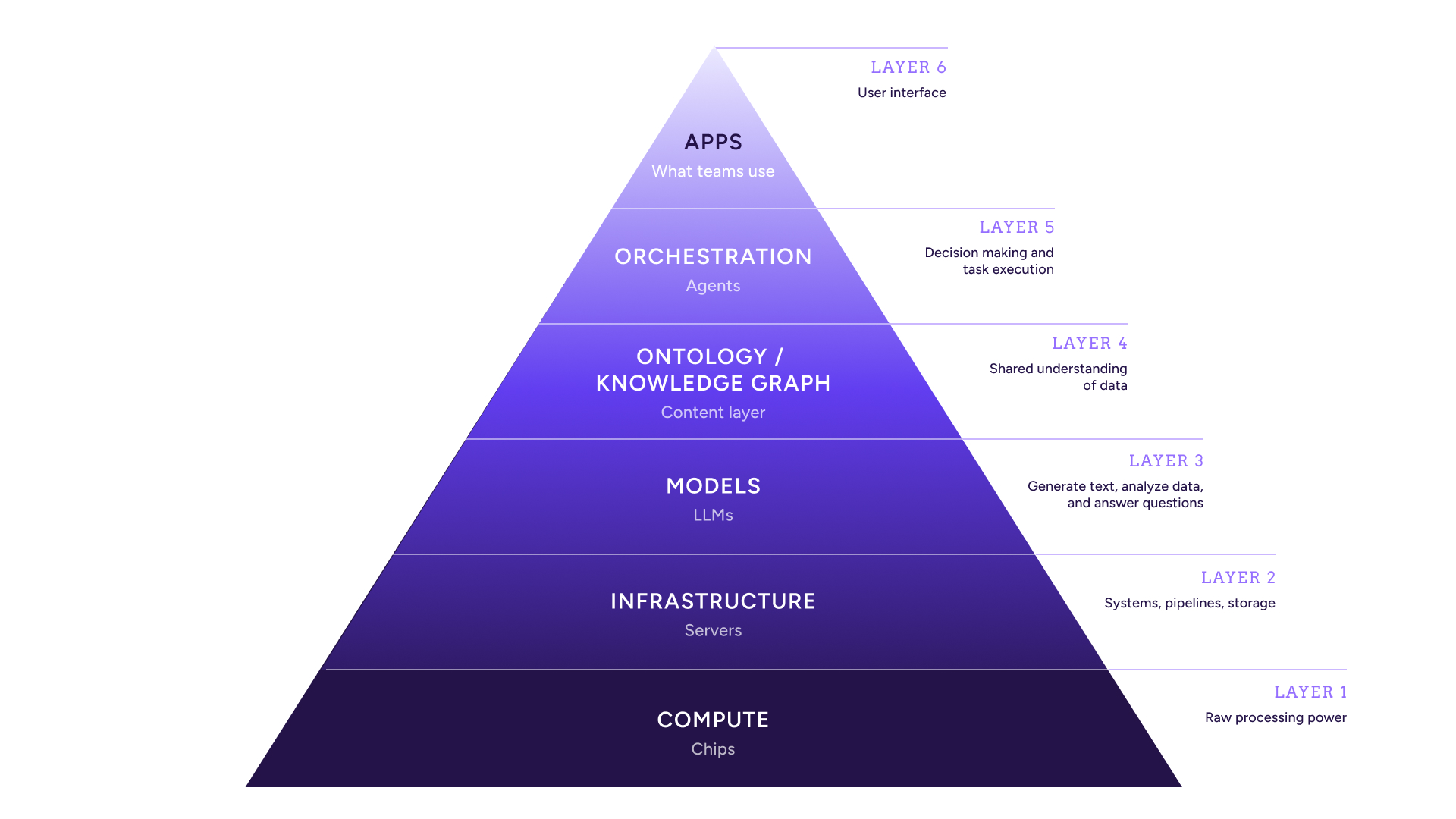
The simplest way to understand AI is as a six-layer stack, each layer building on the one below it.
1. Compute (Chips)
The raw processing power. The hardware that runs everything.
2. Infrastructure (Servers)
Where data lives - systems, pipelines, storage. Most enterprises have already invested heavily here.
3. Models (LLMs)
What most people call “AI.” Models can generate, analyze, and answer. But on their own, they’re stateless, inconsistent, and disconnected from your business. This is where most AI efforts stall.
4. Ontology + Knowledge Graph (The Contextual Layer)
This is the layer most companies skip, and the reason AI doesn’t work at scale or consistently. AI needs a shared understanding of what data means.
- An ontology defines the business - what things are and how they relate. For example, what is a clinical trial, a site, a patient, a cost.
- A knowledge graph connects those definitions to reality: this patient, at this site, in this trial, tied to these costs, over time.
Without this layer, AI guesses and the likelihood of hallucinations is greater. With it, AI understands, reasons, and produces consistent, auditable outputs. Think about it… if you don’t have context, how would that affect your answer to a question?
5. Orchestration (Agents & Workflows)
This is where AI starts doing work. Systems coordinate models, move across workflows, and execute tasks — pulling actuals, reconciling data, flagging exceptions — without manual stitching.
6. Applications (What Users See)
Copilots, automation, decision tools. But this layer is only as good as what’s underneath it.
What This Means for Biopharma & Life Sciences Pharma
AI isn’t just a tool you experiment with; it’s an operating layer. In biopharma, that means handling complex clinical and financial relationships, operating in regulated environments, and producing outputs that are trusted, consistently reliable, and explainable.
When it works, the impact is real: speed and accuracy at precision levels impossible before, with full visibility across clinical and financial data.
Where Condor Fits
At Condor, we’re building the contextual layer — a pharma-specific ontology and knowledge graph connecting clinical and financial data, embedded directly into operations, accruals, financial planning, and budgeting. It’s not another tool. It’s the intelligence layer that makes AI actually work across R&D and finance.
Read the article

The Cost of Saving Lives Shouldn’t Be a Mystery
Today, I'm proud to share that Condor Software has closed a $24 million Series A funding round, led by Insight Partners, with participation from Felicis, 645 Ventures, Pamir Ventures, SNR Ventures, Prebys Ventures, and Bramalea Partners.
Every therapy that reaches a patient is a miracle of science and resilience without financial clarity. Most people involved in therapies focus on science. I focus on finance, and what happens when it breaks down.
Earlier in my career, I worked alongside teams bringing treatments to patients who had run out of options. I watched what it meant to families (including my own), to clinicians, and to entire communities when a therapy worked. I was on the inside, building the accounting workflows the pharmaceutical industry uses to manage clinical trial finances. What I saw blew my mind: organizations managing billions in R&D spend on spreadsheets stitched together late at night. Critical decisions about which therapies move forward, made on data that was fragmented, manually reconciled, erroneous, and months out of date.
Good science was being crushed by broken financial infrastructure. This shouldn’t be the case, and I knew I couldn’t let this continue. So I founded Condor.
A lot has changed since I founded the company five years ago. Our team has grown. Our platform has matured into the first ever AI-powered financial intelligence layer purpose-built for life sciences. And some of the world's most innovative biopharma organizations — like Acadia Pharmaceuticals, Alumis Therapeutics, BridgeBio Pharma, and Madrigal Pharmaceuticals — now rely on Condor to manage over $19 billion in R&D spend.
What hasn't changed is our mission: to empower biopharma teams to see, predict, and control the cost of bringing life-changing therapies to patients. And our mission has never been more urgent.
AI is completely transforming human health, drug discovery, disease prevention, and the way we treat, cure, and care for people. But here's the uncomfortable truth nobody's talking about: the future everyone's envisioning can't actually happen yet. Not because the science isn't ready. Not because the data isn't there, but because the financial infrastructure that has to support it all is broken.
The life sciences industry spends $300 billion a year on R&D. Today, most of that is trapped in spreadsheets, PDFs, and disconnected systems. That is the choke point. That is what's standing between the world we have and the world we're all trying to build.
Condor exists to remove that choke point. We give CFOs, clinical executives, and R&D leaders something the industry has never had: a living, breathing financial command center. The ability to see in real time where every dollar is going, how trials are performing, and where to reallocate and accelerate. It’s all made possible by our platform’s proprietary clinical and financial ontologies that map the relationships between trial protocols, site-level activity, vendor contracts, and accounting rules. The platform’s knowledge architecture was developed over years with Big 4 accounting firms and embedded in audit-grade workflows.
What gets me and everyone at Condor out of bed every morning is witnessing accounting, FP&A, and clinical operations teams have that “aha moment” when they turn on our platform. For example, the CFO of a growing biotech told us recently that for the first time she could see exactly where her clinical trial dollars were going. No spreadsheets stitched together late at night. No uncertainty heading into board meetings. Just a clear, trusted view of trial spend, forecasts, and risk. She told me, “For the first time, I feel like we're making strategic and proactive decisions instead of explaining surprises.”
That shift from reactive to proactive is everything. Better visibility leads to better decisions. Better decisions drive better outcomes. And better outcomes mean more therapies reach the people who need them.
We aren’t building accounting software or a reporting tool. We’re building the infrastructure for how the industry funds innovation itself. Every drug discovered by AI, every molecule modeled, every trial run more efficiently — that future flows through financial infrastructure. Condor is building that infrastructure. This Series A gives us the resources to go further by expanding our platform, deepening our enterprise capabilities, and growing the extraordinary team that will carry this vision forward.
Thank you to our customers for trusting Condor, our team for its unmatched expertise and resilience, and our investors for believing in what’s possible. Together, we’re building the AI-powepred Financial Intelligence Platform that is helping bring life-changing therapies to patients faster.
This vision is worth fighting for. And together, we're proving it.
— Jen
Read the article